
Did you know that there are nearly 291,129 unique Japanese surnames that are recorded across Japan? And it’s not a mistake. Japanese families’ names carry a long history of culture, geography and significance, all contained in only two characters. If you’ve ever searched to find Japanese family names and feel lost in the ocean of unfamiliar terms, there’s a reason for that.
When you’re researching your family’s history, composing a story, choosing a name for an individual, or just interested in Japanese society, this guide is perfect for you.
Japanese names with significance that goes beyond mere translation. They are a reflection of Japanese culture, Japanese values, and the strong connection that people from Japan feel with their environment, nature, and personal identity.
In addition to rare treasures, there are classics with cool sounds. This list of Japanese surnames will be guided by the most intriguing surnames from across Asian culture, presented in clear, easy English.
What Are Japanese Family Names and How Do They Work?
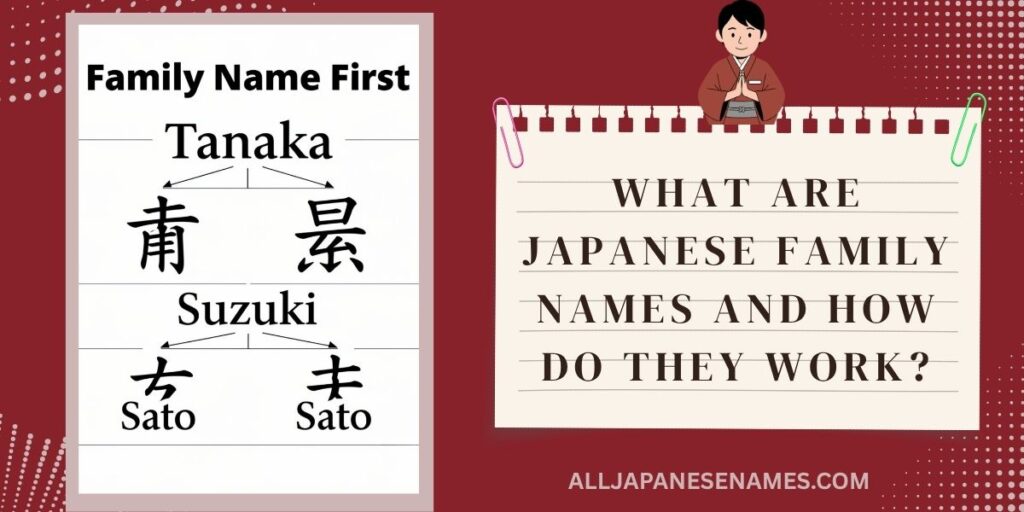
Japanese surnames are preceded by the first name, which is the opposite of that of Western naming. Thus, “Tanaka Yuki” means Yuki from the Tanaka family.
This is something that many do not know: before the Meiji period (1868), only nobles and samurai were allowed to have a hereditary surname. People who were regular Japanese families, merchants, farmers, and everyone else simply did not have one.
The Meiji government mandated that every Japanese household sign up for a family name. This single decision has shaped the way Japanese families are recognised to this day.
Japanese family names are strongly connected to family tradition and family ties. Surnames aren’t just a designation, it’s a representation of the entire group. It can connect family members across generations and keep the family identity alive. This is why, in Japanese life, the name of the family is a major cultural symbol.
Looking for unique Japanese restaurant names inspired by culture, food, and modern dining trends? Explore the complete Japanese restaurant names collection .
How to Say and Write Family Name in Japanese (Pronunciation + Kanji)
For the Japanese, “family name” is written as 名字 or 苗字 and then pronounced myoji. This is how you pronounce the family name Japanese, “myo-ji.” It’s easy once you’ve heard it.
How to write a family name in Japanese depends on the system of writing. Japanese name writing applies 3 scripts: kanji, hiragana (あ) and romaji. The majority of Japanese family names written in kanji utilise Chinese characters with meanings. For example, 田 means “rice field”, and 中 is “middle.” Combine them, “田中” (Tanaka) is an entire surname.
There are a lot of Japanese words that have an identical pronunciation but use completely different kanji characters, as well as kanji variations. This means that Japanese pronunciation alone can’t give you the spelling. This is why romaji (English characters) aids beginners in reading Japanese spellings without confusion.
Is the Japanese language complex? But surnames are an excellent starting point.
Looking for beautiful Japanese flower names inspired by nature and symbolism? Discover the complete Japanese flower names collection .
The Top 10 Most Popular Japanese Family Names
Some Japanese surnames have become so popular that you’ll find them throughout Japan. They’re not just names that are popular, they are deeply woven into Japanese culture and daily life. The Sato surname is used by a large number of people, which makes this the largest and most widespread surname in the entire nation.
Starting from the Suzuki Surname all the way through the Kobayashi surname, each name in the top ten surnames tells a little about Japan’s history, rice fields, mountains, rivers and even villages.
| Name | Meaning | Pronunciation | Kanji |
|---|---|---|---|
| Sato | Village of assistance / helpful hamlet | sah-toh | 佐藤 |
| Suzuki | Bell tree / pampas grass stem | soo-zoo-kee | 鈴木 |
| Takahashi | High bridge | tah-kah-hah-shee | 高橋 |
| Tanaka | One who lives in the middle of rice fields | tah-nah-kah | 田中 |
| Ito | This wisteria / thread | ee-toh | 伊藤 |
| Watanabe | One who crosses the water | wah-tah-nah-beh | 渡辺 |
| Yamamoto | Base of the mountain | yah-mah-moh-toh | 山本 |
| Nakamura | Middle village | nah-kah-moo-rah | 中村 |
| Kobayashi | Small forest | koh-bah-yah-shee | 小林 |
| Saito | Purified wisteria / holy origin | sah-ee-toh | 斉藤 |
Looking for legendary Japanese sword names inspired by samurai history, anime, and mythology? Browse the complete Japanese sword names collection .
Beautiful Japanese Family Names and Their Poetic Meanings
Some Japanese family names are like small poems. They are inspired by the moonlight, nature and the moon, rivers, blossoms and mountains. A lot of them have cultural significance that goes back hundreds of years. What makes the elegant names so special is their ability to hold multiple meanings depending on the Kanji that is used.
One name in Japanese employs imagery inspired by nature to symbolise harmony, beauty, as well as cultural associations that are deeply of Japanese usage for language, identity and even.
| Name | Meaning | Pronunciation | Kanji |
|---|---|---|---|
| Tsukishima | Moon island | tsoo-kee-shee-mah | 月島 |
| Harusaki | Spring cape / blooming headland | hah-roo-sah-kee | 春崎 |
| Mizuhara | Water plain / flowing meadow | mee-zoo-hah-rah | 水原 |
| Kageyama | Shadow mountain | kah-geh-yah-mah | 影山 |
| Hanazono | Flower garden | hah-nah-zoh-noh | 花園 |
| Tsurumi | Crane viewing / watching cranes | tsoo-roo-mee | 鶴見 |
| Aozora | Blue sky | ah-oh-zoh-rah | 青空 |
| Shirakawa | White river | shee-rah-kah-wah | 白川 |
| Moriwaki | Beside the forest | moh-ree-wah-kee | 森脇 |
| Kinoshita | Beneath the trees | kee-noh-shee-tah | 木下 |
| Tsukimoto | Base of the moon / moonlit origin | tsoo-kee-moh-toh | 月本 |
| Harukawa | Spring river | hah-roo-kah-wah | 春川 |
| Yukishiro | White snow castle | yoo-kee-shee-roh | 雪城 |
| Nishikawa | Western river / silk river | nee-shee-kah-wah | 錦川 |
| Fujimori | Wisteria forest | foo-jee-moh-ree | 藤森 |
| Sorano | Of the sky / sky plain | soh-rah-noh | 空野 |
| Himeno | Princess field / princess plain | hee-meh-noh | 姫野 |
| Kawashima | River island | kah-wah-shee-mah | 川島 |
| Sakuragi | Cherry blossom tree | sah-koo-rah-gee | 桜木 |
| Umezawa | Plum tree swamp | oo-meh-zah-wah | 梅沢 |
| Hoshino | Field of stars | hoh-shee-noh | 星野 |
| Taiyoko | Child of the sun | tah-ee-yoh-koh | 太陽子 |
| Nagatsuki | Long moon / lingering moonlight | nah-gah-tsoo-kee | 長月 |
| Shimokawa | Lower river / downstream waters | shee-moh-kah-wah | 下川 |
| Irodori | Colorful / one who brings color | ee-roh-doh-ree | 彩 |
| Kasumigawa | Misty river | kah-soo-mee-gah-wah | 霞川 |
| Shinohara | Bamboo grass plain | shee-noh-hah-rah | 篠原 |
| Murasaki | Purple / violet hue | moo-rah-sah-kee | 紫 |
| Asahina | Morning sun greens / dawn field | ah-sah-hee-nah | 朝比奈 |
| Kagurazaka | Sacred music hill | kah-goo-rah-zah-kah | 神楽坂 |
Looking for meaningful Japanese baby names inspired by tradition, culture, and modern trends? View the complete Japanese baby names collection .
Japanese Family Names With Dark Meanings
There are many different Japanese family names which are gentle and poetic. Certain surnames carry strong, violent or even terrifying meanings that are rooted in Japanese mythology, battle cultures, and perhaps those of the Chinese Zodiac, as well as Chinese constellation systems that were influential in the early Japanese name-naming practices.
Names that have unique meanings were often given to clans of warriors, fearsome families, or areas that were which were associated with darkness and death. They sound awe-inspiring, and that’s precisely the purpose.
| Name | Meaning | Pronunciation | Kanji |
|---|---|---|---|
| Shikigami | Spirit summoned to do dark work | shee-kee-gah-mee | 式神 |
| Kurayami | Total darkness / pitch black | koo-rah-yah-mee | 暗闇 |
| Shinigami | God of death | shee-nee-gah-mee | 死神 |
| Onizuka | Demon hill / hill of the oni | oh-nee-zoo-kah | 鬼塚 |
| Yamikawa | River of darkness | yah-mee-kah-wah | 闇川 |
| Kuroshio | Black current / dark tide | koo-roh-shee-oh | 黒潮 |
| Akutagawa | River of evil / wicked waters | ah-koo-tah-gah-wah | 芥川 |
| Mazoku | Tribe of demons / devil’s clan | mah-zoh-koo | 魔族 |
| Jigokudani | Hell valley | jee-goh-koo-dah-nee | 地獄谷 |
| Noroi | Curse / hex | noh-roh-ee | 呪い |
| Tatariba | Place of curses / cursed ground | tah-tah-ree-bah | 祟り場 |
| Yomotsu | Of the underworld / from Yomi | yoh-moh-tsoo | 黄泉津 |
| Kessho | Blood crystal / fatal beauty | keh-shoh | 血晶 |
| Furyoku | Power of the wind of misfortune | foo-ryoh-koo | 不力 |
| Higekage | Shadow beneath the beard / hidden shadow | hee-geh-kah-geh | 髭影 |
| Dokugawa | Poison river | doh-koo-gah-wah | 毒川 |
| Yamikumo | Dark cloud / shadow cloud | yah-mee-koo-moh | 闇雲 |
| Shiryoku | Power of the dead / spirit force | shee-ryoh-koo | 死力 |
| Akuma | Devil / evil spirit | ah-koo-mah | 悪魔 |
| Konton | Chaos / disorder | kohn-tohn | 混沌 |
| Meikyu | Dark labyrinth / maze of shadows | meh-ee-kyoo | 迷宮 |
| Fujin | God of destructive winds | foo-jeen | 風神 |
| Raijin | God of thunder and lightning storms | rah-ee-jeen | 雷神 |
| Tateyama | Standing mountain of swords | tah-teh-yah-mah | 立山 |
| Ankoku | Pitch darkness / total blackout | ahn-koh-koo | 暗黒 |
| Yamibito | Person of darkness / shadow dweller | yah-mee-bee-toh | 闇人 |
| Karasu | Crow / dark omen bird | kah-rah-soo | 烏 |
| Shikabane | Corpse / dead body | shee-kah-bah-neh | 屍 |
| Mazuki | Cursed moon / demon moon | mah-zoo-kee | 魔月 |
| Goroshi | The act of killing / slayer | goh-roh-shee | 殺し |
Looking for elegant and meaningful Japanese girl names inspired by beauty, culture, and modern trends? Discover the complete Japanese girl names collection .
Strong and Powerful Japanese Family Names (With Origins)
A strong Japanese family name usually originated from samurai clans, military commanders and traditional occupations like blacksmithing, guarding and fighting.
These strong Japanese family names imply strength, power and dominance were not randomly chosen, certain names were earned through loyalty, battle or ownership of land. Many of them are proper names still carried by families from across Japan in the present. If you’re looking for names that are powerful and stand out, the list below will do what you want.
| Name | Meaning | Pronunciation | Kanji |
|---|---|---|---|
| Takeru | Brave / ferociously strong warrior | tah-keh-roo | 武 |
| Kenzan | Sword mountain / sharp summit | kehn-zahn | 剣山 |
| Hayabusa | Peregrine falcon / swift hunter | hah-yah-boo-sah | 隼 |
| Ikazuchi | Thunder / raw electric power | ee-kah-zoo-chee | 雷 |
| Gokenin | Honorable house guard / loyal protector | goh-keh-neen | 御家人 |
| Tsuwamono | Soldier / man of arms | tsoo-wah-moh-noh | 兵 |
| Ryugoku | Dragon country / land of dragons | ryoo-goh-koo | 龍国 |
| Bunshin | Split warrior spirit / fighting force | boon-sheen | 分身 |
| Tetsuya | Iron arrow / steel night | teh-tsoo-yah | 鉄矢 |
| Aragaki | Wild stone wall / rough fortress | ah-rah-gah-kee | 荒垣 |
| Kamikaze | Divine wind / godly storm force | kah-mee-kah-zeh | 神風 |
| Dairyu | Great dragon / massive power | dah-ee-ryoo | 大龍 |
| Musha | Armed warrior / fighter by trade | moo-shah | 武者 |
| Yorozu | Ten thousand things / limitless strength | yoh-roh-zoo | 万 |
| Katsumoto | Origin of victory / winning root | kah-tsoo-moh-toh | 勝本 |
| Haganemura | Steel village / iron community | hah-gah-neh-moo-rah | 鋼村 |
| Inukai | Dog keeper / fierce guardian handler | ee-noo-kah-ee | 犬養 |
| Kibayashi | Yellow wood forest / resilient timber clan | kee-bah-yah-shee | 黄林 |
| Tategami | Standing mane / lion’s fierce pride | tah-teh-gah-mee | 立髪 |
| Ozora | Great sky / vast open power above | oh-zoh-rah | 大空 |
| Battosai | Master of the drawn sword | baht-toh-sah-ee | 抜刀斎 |
| Kurogane | Black iron / unbreakable dark metal | koo-roh-gah-neh | 鉄 |
| Seiryu | Blue dragon / eastern guardian beast | seh-ee-ryoo | 青龍 |
| Masamune | Righteous axe / legendary swordsmith name | mah-sah-moo-neh | 正宗 |
| Naginata | Pole blade / traditional weapon bearer | nah-gee-nah-tah | 薙刀 |
| Toramaru | Tiger circle / fierce and complete strength | toh-rah-mah-roo | 虎丸 |
| Hisamoto | Long-lasting origin / enduring power base | hee-sah-moh-toh | 久本 |
| Arashiyama | Storm mountain / mountain of wild winds | ah-rah-shee-yah-mah | 嵐山 |
| Kongoji | Diamond temple / indestructible sacred ground | kohn-goh-jee | 金剛寺 |
| Tetsumaru | Iron circle / complete and unbreakable force | teh-tsoo-mah-roo | 鉄丸 |
Looking for powerful and meaningful Japanese male names inspired by tradition, strength, and modern culture? Browse the complete Japanese male names collection .
Cute Japanese Family Names
Pretty Japanese family names have a warm, soft and even playful sound to their sound. They’re almost playful. They are great when paired with first names, too.
Imagine calling someone Yuki Tanaka, or combining the first name Yuki with any of these surnames. The combination just flows naturally. The names are sweet and have associations with nature, small, light and beautiful things. They’re easy on the tongue and delightful to listen to.
| Name | Meaning | Pronunciation | Kanji |
|---|---|---|---|
| Kotone | Sound of the harp / gentle melody | koh-toh-neh | 琴音 |
| Himari | Sunflower / warm and bright like sunshine | hee-mah-ree | 向日葵 |
| Konpeki | Deep azure blue / clear sky color | kohn-peh-kee | 紺碧 |
| Momose | Hundred rapids / lively little stream | moh-moh-seh | 百瀬 |
| Nanami | Seven seas / beautiful and wide | nah-nah-mee | 七海 |
| Tamagawa | Jewel river / sparkling water | tah-mah-gah-wah | 玉川 |
| Usagi | Rabbit / soft and gentle creature | oo-sah-gee | 兎 |
| Kohana | Little flower / tiny blossom | koh-hah-nah | 小花 |
| Suzume | Little sparrow / cheerful small bird | soo-zoo-meh | 雀 |
| Nijiiro | Rainbow colored / full of color and joy | nee-jee-ee-roh | 虹色 |
| Haruno | Spring field / warm open meadow | hah-roo-noh | 春野 |
| Kirameki | Glitter / sparkling and shining brightly | kee-rah-meh-kee | 煌めき |
| Komachi | Little town girl / cute village beauty | koh-mah-chee | 小町 |
| Fuwari | Fluffy / soft and light as a feather | foo-wah-ree | ふわり |
| Peachi | Peach blossom / sweet and fruity warmth | peh-ah-chee | 桃花 |
| Tsukiko | Moon child / little one born under moonlight | tsoo-kee-koh | 月子 |
| Hanamichi | Flower path / road lined with blossoms | hah-nah-mee-chee | 花道 |
| Yukiwa | Snow ring / snowflake circle | yoo-kee-wah | 雪輪 |
| Komugi | Wheat / small and nourishing like grain | koh-moo-gee | 小麦 |
| Hinatabo | Sunny spot / warm patch of sunlight | hee-nah-tah-boh | 日向ぼ |
| Takenoko | Bamboo shoot / young and fresh growth | tah-keh-noh-koh | 竹の子 |
| Chiroru | Falling petals / scattered cherry blossoms | chee-roh-roo | 散る |
| Mochida | Rice cake field / soft and round like mochi | moh-chee-dah | 餅田 |
| Fujioka | Wisteria hill / gentle purple flower slope | foo-jee-oh-kah | 藤岡 |
| Hotarubi | Firefly light / soft glowing little light | hoh-tah-roo-bee | 蛍火 |
| Tamago | Egg / round, small and full of potential | tah-mah-goh | 卵 |
| Kokorono | Of the heart / one who lives with feeling | koh-koh-roh-noh | 心の |
| Shirotama | White jewel / pure and precious little gem | shee-roh-tah-mah | 白玉 |
| Momijida | Maple leaf field / warm autumn color place | moh-mee-jee-dah | 紅葉田 |
| Hanabi | Fireworks / flower fire in the night sky | hah-nah-bee | 花火 |
Rare and Unique Japanese Family Names Most People Have Never Heard Of
The majority of people are familiar with surnames such as Ishikawa, or that is the Matsumoto surname, Nakagawa, Kitagawa, Yokoyama, Fujita, Miyamoto, Iwasaki, the Hayashi surname, Ichikawa, the Shimizu surname and the Yamaguchi surname and Miyazaki.
However, Japan’s name world extends far beyond the above. Some Japanese family names are so rare that Japanese users look at each other in awe when they are introduced to these names. Some are simple Japanese family names that are only two syllables long, whereas some are longer and layered with historical significance.
These distinctive Japanese family names are derived from small villages, forgotten clans and dialects from regions that the majority of people haven’t even heard of. If you’re searching for something truly unique, this list is the perfect choice for you.
| Name | Meaning | Pronunciation | Kanji |
|---|---|---|---|
| Kisaragi | February moon / month of changing seasons | kee-sah-rah-gee | 如月 |
| Utsunomiya | Palace of the right / noble dwelling place | oo-tsoo-noh-mee-yah | 宇都宮 |
| Wadatsumi | God of the sea / ancient ocean ruler | wah-dah-tsoo-mee | 海神 |
| Tsuruoka | Crane hill / graceful elevated land | tsoo-roo-oh-kah | 鶴岡 |
| Kamiishii | Upper stone well / sacred water source | kah-mee-ee-shee-ee | 上石井 |
| Yachimata | Eight crossroads / place of many paths | yah-chee-mah-tah | 八街 |
| Nishizawa | Western mountain swamp / western marsh clan | nee-shee-zah-wah | 西沢 |
| Hachisuka | Eight hills / ancient clan of the highlands | hah-chee-soo-kah | 蜂須賀 |
| Otoguro | Sound of darkness / echoing black | oh-toh-goo-roh | 音黒 |
| Minakami | Above the water source / upstream origin | mee-nah-kah-mee | 水上 |
| Kajiwara | Blacksmith plain / iron worker’s open land | kah-jee-wah-rah | 梶原 |
| Tobishima | Flying island / island that leaps from the sea | toh-bee-shee-mah | 飛島 |
| Kushida | Skewer rice field / old agricultural clan | koo-shee-dah | 串田 |
| Izumida | Fountain rice field / spring water farmland | ee-zoo-mee-dah | 泉田 |
| Namekata | Flowing shape / name of a rare coastal region | nah-meh-kah-tah | 行方 |
| Habagawa | Wing river / river of wide open shores | hah-bah-gah-wah | 羽川 |
| Rokugawa | Six rivers / land where six streams meet | roh-koo-gah-wah | 六川 |
| Tominaga | Wealthy and long / prosperous lasting clan | toh-mee-nah-gah | 富永 |
| Sakisaka | Cape slope / headland on a hillside | sah-kee-sah-kah | 崎坂 |
| Higashino | Eastern field / land to the east of the village | hee-gah-shee-noh | 東野 |
| Kanenaga | Long gold / lasting wealth and prosperity | kah-neh-nah-gah | 金永 |
| Yotsumoto | Four origins / clan of four founding roots | yoh-tsoo-moh-toh | 四本 |
| Shimotsuki | Frost month / name tied to late autumn cold | shee-moh-tsoo-kee | 霜月 |
| Kakiuchi | Inside the fence / protected inner settlement | kah-kee-oo-chee | 垣内 |
| Narusawa | Sounding swamp / marsh that echoes with noise | nah-roo-sah-wah | 鳴沢 |
| Hirukawa | Midday river / river bright under the noon sun | hee-roo-kah-wah | 昼川 |
| Ozaki | Large cape / wide coastal headland | oh-zah-kee | 尾崎 |
| Funabashi | Boat bridge / crossing made of vessels | foo-nah-bah-shee | 船橋 |
| Kameyama | Turtle mountain / slow and steady ancient hill | kah-meh-yah-mah | 亀山 |
| Nagumo | Calm cloud / quiet drifting sky formation | nah-goo-moh | 南雲 |
Cool Japanese Family Names for Fiction Writers and Worldbuilders
If you’re creating a manga story or writing anime fanfiction or creating the characters you want to use in Japanese series and Japanese multimedia projects, choosing the right surname can mean much. A great Japanese surname can reveal who the character is before they speak. Look for names that are clear as well as memorable.
They are visually stunning and unforgettable. Avoid the overused Western language translations, instead focus on the natural tone of the Japanese names for families below. Take into consideration the character’s traits first. A quiet assassin will require an entirely distinct name from a lively chef with a Japanese cook show background.
These names can be used to create Japanese-style nicknames or make them shorter to nicknames for use in casual conversations. These names are derived from the world of combat, nature elements and nature. Each one is unique.
| Name | Meaning | Pronunciation | Kanji |
|---|---|---|---|
| Zenkoji | Temple of good fortune / virtuous shrine | zehn-koh-jee | 善光寺 |
| Ryonagi | Cool dragon willow / swift and flexible force | ryoh-nah-gee | 龍柳 |
| Kazemaru | Wind circle / one who moves like the wind | kah-zeh-mah-roo | 風丸 |
| Homuragi | Flame tree / burning with quiet intensity | hoh-moo-rah-gee | 炎木 |
| Shizukana | Quiet and calm / still like deep water | shee-zoo-kah-nah | 静かな |
| Tokkuri | Sake flask / one who carries ancient tradition | tohk-koo-ree | 徳利 |
| Kagamino | Mirror field / one who reflects all things | kah-gah-mee-noh | 鏡野 |
| Hibikiro | Echoing black / resonating darkness | hee-bee-kee-roh | 響黒 |
| Rasetsu | Demon warrior spirit / fearsome fighter | rah-seh-tsoo | 羅刹 |
| Yukikaze | Snow wind / cold and cutting winter storm | yoo-kee-kah-zeh | 雪風 |
| Genshiro | Original white castle / ancient pure origin | gehn-shee-roh | 源白城 |
| Enbaku | Flame explosion / sudden burst of fire power | ehn-bah-koo | 炎爆 |
| Kurotsuki | Black moon / dark side of the lunar cycle | koo-roh-tsoo-kee | 黒月 |
| Hayatemaru | Swift storm circle / speeding whirlwind force | hah-yah-teh-mah-roo | 疾風丸 |
| Mizukagami | Water mirror / still surface that shows truth | mee-zoo-kah-gah-mee | 水鏡 |
| Tsubakuro | Black swallow / swift dark bird of passage | tsoo-bah-koo-roh | 燕黒 |
| Izanagi | He who invites / creator god of ancient myth | ee-zah-nah-gee | 伊邪那岐 |
| Ryogetsu | Cool moon / refreshing lunar light | ryoh-geh-tsoo | 涼月 |
| Kaminari | Thunder god / one who strikes with lightning | kah-mee-nah-ree | 雷 |
| Fubukida | Blizzard field / snowstorm swept open land | foo-boo-kee-dah | 吹雪田 |
| Tsukiakari | Moonlight / the glow that lights the night path | tsoo-kee-ah-kah-ree | 月明り |
| Maboroshi | Illusion / a vision that fades like a dream | mah-boh-roh-shee | 幻 |
| Kokuryuu | Black dragon / most feared beast of the sky | koh-koo-ryoo | 黒龍 |
| Arashi | Storm / raw and uncontrolled natural power | ah-rah-shee | 嵐 |
| Shinkiro | Mirage / something seen but never truly there | sheen-kee-roh | 蜃気楼 |
| Byakuya | White night / endless light with no darkness | byah-koo-yah | 白夜 |
| Tamashii | Soul / the core spirit that drives a person | tah-mah-shee-ee | 魂 |
| Gekkoukan | Moonlight mansion / grand hall under the moon | gehk-koh-kahn | 月光館 |
| Raikoken | Thunder sword / blade that strikes like lightning | rah-ee-koh-kehn | 雷光剣 |
| Mugenkai | Infinite world / a realm with no boundaries | moo-gehn-kah-ee | 無限界 |
Famous, Noble, and Prestigious Japanese Family Names Through History
Japan has a long tradition that includes distinguished families whose names have shaped the country’s history. They’re not just traditional Japanese names of families They’re living pieces of family history that connect modern Japan to pre-modern Japan as well as premodern Japan as well. A lot of families were able to carry their lineage through the centuries of power in the political realm, military supremacy or royal service.
Most well-known is the historical Fujiwara clan, which is also known as Fujihara in certain regional documents. The Fujiwara/Fujihara clan was the ruler of Japan’s imperial court for over 300 years, but never on the throne. This shows the power of a family name could be. Their ancestors created systems of governance which shaped Japanese noble names over generations that followed them.
These highly regarded Japanese names of families below belong to clans, official officials of the court, Samurai Lords, and other famous Japanese family names that are linked to the bloodlines of ancient times. If you’re trying to find your lineage or just want to know more about the history of Japanese name families, this listing will give an insight into the history of Japan.
| Name | Meaning | Pronunciation | Kanji |
|---|---|---|---|
| Fujiwara | Wisteria plain / seat of ancient imperial power | foo-jee-wah-rah | 藤原 |
| Minamoto | Origin / founding source of the warrior class | mee-nah-moh-toh | 源 |
| Taira | Flat / calm and powerful ruling clan | tah-ee-rah | 平 |
| Tokugawa | Virtuous river / dynasty that ruled for 265 years | toh-koo-gah-wah | 徳川 |
| Ashikaga | Reed deer / shogunate clan of medieval Japan | ah-shee-kah-gah | 足利 |
| Oda | Small rice field / clan of the great unifier Nobunaga | oh-dah | 織田 |
| Toyotomi | Abundant wealth of the nation / supreme ruler clan | toh-yoh-toh-mee | 豊臣 |
| Shimazu | Island ford / powerful southern Japan noble clan | shee-mah-zoo | 島津 |
| Mori | Forest / western Japan clan of great military strength | moh-ree | 毛利 |
| Uesugi | Above the cedar / noble family of the Kanto region | oo-eh-soo-gee | 上杉 |
| Takeda | Warrior rice field / fierce cavalry clan of Kai | tah-keh-dah | 武田 |
| Date | 伊達 / bold and daring northern lord clan | dah-teh | 伊達 |
| Hojo | North strip of land / regent clan of Kamakura era | hoh-joh | 北条 |
| Sanada | True field / legendary warrior family of Shinano | sah-nah-dah | 真田 |
| Chosokabe | Long bundle place / ruling clan of Shikoku island | choh-soh-kah-beh | 長宗我部 |
| Imagawa | Now river / powerful Tokaido road ruling family | ee-mah-gah-wah | 今川 |
| Asakura | Morning storehouse / noble clan of Echizen province | ah-sah-koo-rah | 朝倉 |
| Hatakeyama | Flag mountain / distinguished family of central Japan | hah-tah-keh-yah-mah | 畠山 |
| Ouchi | Great interior / wealthy western Honshu noble clan | oh-oo-chee | 大内 |
| Rokkaku | Six corners / ancient noble clan of Omi province | rohk-kah-koo | 六角 |
| Kikuchi | Chrysanthemum land / distinguished Kyushu warrior family | kee-koo-chee | 菊池 |
| Yamana | Mountain name / clan that once ruled eleven provinces | yah-mah-nah | 山名 |
| Otomo | Great friend / one of Japan’s oldest recorded noble clans | oh-toh-moh | 大友 |
| Nijo | Second street / Kyoto court noble family of high rank | nee-joh | 二条 |
| Konoe | Imperial guard / one of the five highest noble houses | koh-noh-eh | 近衛 |
| Ichijo | First street / royal Kyoto family of supreme court rank | ee-chee-joh | 一条 |
| Kujo | Ninth street / ancient aristocratic court family of Kyoto | koo-joh | 九条 |
| Tsutsui | Tube well / old Yamato province warrior noble family | tsoo-tsoo-ee | 筒井 |
| Ogasawara | Small笠 plain / clan known for archery and etiquette | oh-gah-sah-wah-rah | 小笠原 |
| Nitta | New rice field / warrior clan descended from Minamoto line | nee-tah | 新田 |
Japanese Samurai Family Names and Their Clan Crests (Mon)
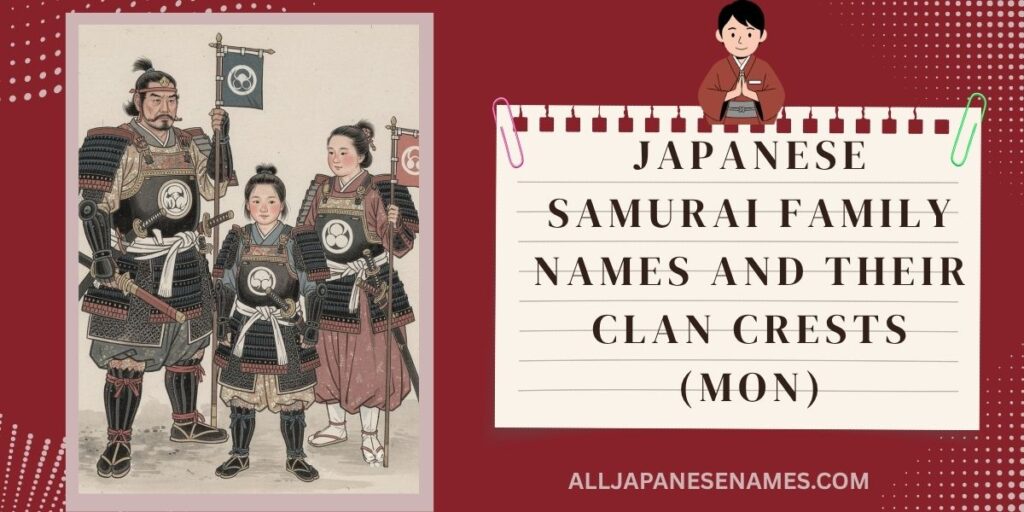
Japanese Samurai names were not only surnames. They represented whole clans with their unique clan mons, which were crests of the clan. From the powerful Yamato clan to the feared regional samurai. Each name was a symbol of honour, blood, and battle time.
| Name | Meaning | Pronunciation | Kanji |
|---|---|---|---|
| Shingen | True mystery / title of the great Takeda war lord | sheen-gehn | 信玄 |
| Kenshin | Sword heart / spirit of the devoted blade warrior | kehn-sheen | 謙信 |
| Nobunaga | Prosperous and long / name of Japan’s great unifier | noh-boo-nah-gah | 信長 |
| Hideyoshi | Excellent and good / supreme ruler from peasant origins | hee-deh-yoh-shee | 秀吉 |
| Ieyasu | Family peace / founder of the Tokugawa shogunate | ee-eh-yah-soo | 家康 |
| Yukimura | Snow village / legendary Sanada warrior of Osaka | yoo-kee-moo-rah | 幸村 |
| Musashi | Warrior of the plains / name of Japan’s greatest swordsman | moo-sah-shee | 武蔵 |
| Kojiro | Small second son / rival swordsman of legendary duels | koh-jee-roh | 小次郎 |
| Nagamasa | Long righteous / loyal samurai lord of Omi province | nah-gah-mah-sah | 長政 |
| Motochika | Origin of wisdom / Chosokabe clan leader of Shikoku | moh-toh-chee-kah | 元親 |
| Terumoto | Shining origin / Mori clan leader of western Japan | teh-roo-moh-toh | 輝元 |
| Yoshitsune | Good always / beloved tragic hero of the Minamoto clan | yoh-shee-tsoo-neh | 義経 |
| Masashige | Righteous and prosperous / loyal samurai of Emperor Go-Daigo | mah-sah-shee-geh | 正成 |
| Yorimoto | Trustworthy origin / first shogun of the Kamakura period | yoh-ree-moh-toh | 頼朝 |
| Muneshige | Prosperous clan / Tachibana samurai lord of Kyushu | moo-neh-shee-geh | 統虎 |
| Naomasa | Direct and righteous / one of Tokugawa’s four guardians | nah-oh-mah-sah | 直政 |
| Tadakatsu | Loyal and victorious / never wounded warrior of Tokugawa | tah-dah-kah-tsoo | 忠勝 |
| Kazutoyo | Harmonious and prosperous / wise lord of Tosa domain | kah-zoo-toh-yoh | 一豊 |
| Harumoto | Spring origin / Miyoshi clan shogunate power figure | hah-roo-moh-toh | 晴元 |
| Yoshiaki | Good and bright / last Ashikaga shogun of Japan | yoh-shee-ah-kee | 義昭 |
| Ujiyasu | Clan peace / brilliant defensive strategist of Hojo clans | oo-jee-yah-soo | 氏康 |
| Harunaga | Spring long / senior official of the Toyotomi administration | hah-roo-nah-gah | 治長 |
| Mitsuhide | Light and excellence / the samurai who betrayed Nobunaga | mee-tsoo-hee-deh | 光秀 |
| Yoshimoto | Good origin / powerful Imagawa clan lord of Suruga | yoh-shee-moh-toh | 義元 |
| Katsuie | Victorious house / fierce Oda clan general of the north | kah-tsoo-ee-eh | 勝家 |
| Hiroie | Wide house / Kikkawa clan diplomat who saved the Mori | hee-roh-ee-eh | 広家 |
| Naoie | Direct house / Ukita clan founder of Bizen province | nah-oh-ee-eh | 直家 |
| Yoshihiro | Good and wide / fearless Shimazu general at Sekigahara | yoh-shee-hee-roh | 義弘 |
| Masanori | Righteous rule / bold Fukushima clan general of the west | mah-sah-noh-ree | 正則 |
| Takatora | High tiger / master castle builder who served seven lords | tah-kah-toh-rah | 高虎 |
Japanese Royal and Imperial Family Names And Why the Emperor Has None
There’s an interesting fact that is unsettling to many people. The Japanese imperial family has no surname. The King of Japan is the only one within the nation without a family name because it is the imperial family sits above the normal naming system completely.
The members of the Japanese royal family have the imperial name and title instead. When a woman gets married to the Japanese imperial family, she will give up her name permanently. That’s the way it works and has worked for more than 1000 years.
The names listed below belong to princes, branches and family members who are connected to the imperial family throughout Japanese history.
| Name | Meaning | Pronunciation | Kanji |
|---|---|---|---|
| Yamato | Great harmony / original name of the Japanese imperial state | yah-mah-toh | 大和 |
| Mikasa | Three bamboo hats / name of an imperial branch family | mee-kah-sah | 三笠 |
| Takamatsu | High pine tree / imperial branch of the Showa era | tah-kah-mah-tsoo | 高松 |
| Chichibu | Father and mother land / beloved imperial prince branch | chee-chee-boo | 秩父 |
| Katsura | Japanese Judas tree / historic imperial villa family branch | kah-tsoo-rah | 桂 |
| Fushimi | Crouching water view / major branch of imperial lineage | foo-shee-mee | 伏見 |
| Arisugawa | Existing river / prestigious imperial branch now extinct | ah-ree-soo-gah-wah | 有栖川 |
| Kan-in | Barrier court / one of four senior imperial branch houses | kahn-een | 閑院 |
| Hirohito | Abundant benevolence / personal name of the Showa Emperor | hee-roh-hee-toh | 裕仁 |
| Akihito | Bright and benevolent / personal name of the Heisei Emperor | ah-kee-hee-toh | 明仁 |
| Naruhito | Becoming benevolent / name of Japan’s current reigning Emperor | nah-roo-hee-toh | 徳仁 |
| Fumihito | Literary benevolence / name of Prince Akishino current heir | foo-mee-hee-toh | 文仁 |
| Hisahito | Long benevolence / name of the current imperial heir apparent | hee-sah-hee-toh | 悠仁 |
| Masako | Elegant child / name of the current Empress of Japan | mah-sah-koh | 雅子 |
| Aiko | Love child / name of Princess Toshi daughter of Naruhito | ah-ee-koh | 愛子 |
| Mako | True child / former princess who gave up imperial status | mah-koh | 真子 |
| Kako | Flower child / younger daughter of Prince Akishino branch | kah-koh | 佳子 |
| Norihito | Rule benevolence / name of Prince Takamado of imperial family | noh-ree-hee-toh | 憲仁 |
| Tomohito | Friend benevolence / Prince Mikasa’s son of imperial branch | toh-moh-hee-toh | 寬仁 |
| Yasuhito | Peace benevolence / formal name of Prince Chichibu branch | yah-soo-hee-toh | 雍仁 |
| Nobuhito | Trust benevolence / name of Prince Takamatsu imperial line | noh-boo-hee-toh | 宣仁 |
| Takahito | Noble benevolence / name of Prince Mikasa of Showa era | tah-kah-hee-toh | 崇仁 |
| Yoshihito | Good benevolence / personal name of Emperor Taisho of Japan | yoh-shee-hee-toh | 嘉仁 |
| Mutsuhito | Harmonious benevolence / personal name of Emperor Meiji himself | moo-tsoo-hee-toh | 睦仁 |
| Sachinomiya | Palace of happiness / childhood title of Emperor Hirohito | sah-chee-noh-mee-yah | 迪宮 |
| Atsunomiya | Warm palace / childhood imperial title of Emperor Taisho | ah-tsoo-noh-mee-yah | 明宮 |
| Tsugumiya | Succeeding palace / childhood title of current Emperor Naruhito | tsoo-goo-mee-yah | 浩宮 |
| 礼宮Fumiya | Courteous palace / childhood title of Prince Akishino himself | foo-mee-yah | 礼宮 |
| Yosonomiya | Good garden palace / ancient title of imperial court princes | yoh-soh-noh-mee-yah | 良宮 |
| Wakamiya | Young palace / title given to young male imperial heirs | wah-kah-mee-yah | 若宮 |
Japanese Yakuza Family Names
Japanese Yakuza families are dark and have a street-level story. Many people aren’t aware that a significant percentage of Yakuza members were historically Korean immigrants who migrated to Japan following World War II.
Many of them adopted Japanese names to blend in with the Japanese, while some kept Korean names like Kim’s names of their fathers, such as Kim.
Chinese family names are also featured in Yakuza, the past, illustrating the way that migration across Asia has shaped Japan’s underground.
Chinese or Korean groups in Japan were subject to discrimination and were often pushed towards criminal groups. These names are associated with actual Yakuza clans and criminals throughout Japan.
| Name | Meaning | Pronunciation | Kanji |
|---|---|---|---|
| Yamaguchi | Mountain mouth / name of Japan’s largest Yakuza syndicate | yah-mah-goo-chee | 山口 |
| Inagawa | Boar river / name of Tokyo’s historic Yakuza organization | ee-nah-gah-wah | 稲川 |
| Sumiyoshi | Pure good / name of Japan’s second largest crime syndicate | soo-mee-yoh-shee | 住吉 |
| Goto | Behind wisteria / name of a notorious Yamaguchi-gumi boss | goh-toh | 後藤 |
| Tsuruta | Crane rice field / name linked to early postwar Yakuza clans | tsoo-roo-tah | 鶴田 |
| Taoka | Rice field hill / surname of legendary Yamaguchi-gumi founder | tah-oh-kah | 田岡 |
| Shinobu | Endure / name tied to a major breakaway Yakuza faction | shee-noh-boo | 忍 |
| Ozaki | Tail cape / surname used by several regional Yakuza bosses | oh-zah-kee | 尾崎 |
| Kodo | Lofty road / name of the Kodo-kai powerful Nagoya faction | koh-doh | 弘道 |
| Nishikawa | Western river / surname found in Osaka underworld families | nee-shee-kah-wah | 西川 |
| Watari | Crossing / drifter surname common among stateless Yakuza members | wah-tah-ree | 渡 |
| Kubota | Rice paddy of the jar / name used in Kyushu criminal networks | koo-boh-tah | 久保田 |
| Matsuba | Pine needle / name of a Tokyo-based Yakuza organization | mah-tsoo-bah | 松葉 |
| Dojima | Earth island / historic Osaka district tied to crime families | doh-jee-mah | 堂島 |
| Naniwa | Waves of difficulty / old Osaka name used in underworld circles | nah-nee-wah | 浪速 |
| Hamasaki | Beach cape / surname found in Kobe port criminal history | hah-mah-sah-kee | 浜崎 |
| Kyosei | Forced control / name tied to coercive underworld operations | kyoh-seh-ee | 強制 |
| Hanabishi | Flower diamond / crest name used by old gambling crime groups | hah-nah-bee-shee | 花菱 |
| Kizugawa | Wound river / name carrying a dark territorial history | kee-zoo-gah-wah | 木津川 |
| Ryudo | Dragon road / name used in fictional and real crime organizations | ryoo-doh | 龍道 |
| Kumicho | Group leader / title-turned-surname for top Yakuza bosses | koo-mee-choh | 組長 |
| Shinoda | New rice field / surname of a prominent Yamaguchi-gumi figure | shee-noh-dah | 篠田 |
| Takayama | High mountain / name of a senior Yamaguchi-gumi organization boss | tah-kah-yah-mah | 高山 |
| Muraken | Village sword / street-level enforcer clan surname | moo-rah-kehn | 村剣 |
| Kamijima | Upper island / name tied to island-based smuggling operations | kah-mee-jee-mah | 上島 |
| Kurahashi | Storehouse bridge / name used in black market trading families | koo-rah-hah-shee | 倉橋 |
| Nishino | Western field / surname appearing in Kansai crime family records | nee-shee-noh | 西野 |
| Tojima | Fight island / name associated with territorial waterfront gangs | toh-jee-mah | 闘島 |
| Gokumon | Prison gate / historical name for those guarding execution grounds | goh-koo-mohn | 獄門 |
| Kanemoto | Money origin / surname linked to Yakuza financial operations | kah-neh-moh-toh | 金本 |
Unisex Japanese Family Names
Japanese family names themselves are gender-neutral. The same surname is used across the entire family. What does change is the used name that is followed by.
Thus, a family name like Kishi works equally well for children, parents, children and grandparents, no matter what gender. Names represent the entire family, not an individual.
Japanese Male Family Names
Japanese male family names are often paired with bold, strong initial names. The surname is neutral, certain names were historically used by males who held leadership positions in military service or in trade.
| Name | Meaning | Pronunciation | Kanji |
|---|---|---|---|
| Kishi | Beach shore / name carried by strong coastal clans | kee-shee | 岸 |
| Taguchi | Rice field mouth / old farming community family name | tah-goo-chee | 田口 |
| Nozaki | Field cape / open land near a coastal headland | noh-zah-kee | 野崎 |
| Iwata | Rock rice field / sturdy and grounded family origin | ee-wah-tah | 岩田 |
| Kubo | Hollow / sunken land with deep historical roots | koo-boh | 久保 |
| Matsuo | Pine tail / name of the famous haiku poet Basho | mah-tsoo-oh | 松尾 |
| Ueno | Upper field / name tied to historic Tokyo district | oo-eh-noh | 上野 |
| Hamada | Beach rice field / coastal farming community surname | hah-mah-dah | 浜田 |
| Ogawa | Small river / gentle stream running through village land | oh-gah-wah | 小川 |
| Maeda | Front rice field / name of a powerful feudal lord clan | mah-eh-dah | 前田 |
| Okamoto | Hill origin / family settled at the base of a hill | oh-kah-moh-toh | 岡本 |
| Hirano | Flat field / wide open plain community surname | hee-rah-noh | 平野 |
| Morita | Forest rice field / name rooted in woodland farming | moh-ree-tah | 森田 |
| Takeuchi | Bamboo interior / family who lived inside bamboo groves | tah-keh-oo-chee | 竹内 |
| Nishida | Western rice field / farming clan west of the village | nee-shee-dah | 西田 |
| Endo | Far wisteria / distant noble branch of the Fujiwara line | ehn-doh | 遠藤 |
| Aoki | Blue tree / evergreen family name with fresh origins | ah-oh-kee | 青木 |
| Sugawara | Sedge plain / name of a beloved Heian era scholar | soo-gah-wah-rah | 菅原 |
| Kato | Add wisteria / widespread name of noble clan descent | kah-toh | 加藤 |
| Yamashita | Below the mountain / family settled at a mountain’s base | yah-mah-shee-tah | 山下 |
| Inoue | Above the well / family living near a water source | ee-noh-oo-eh | 井上 |
| Murata | Village rice field / tight-knit rural community family name | moo-rah-tah | 村田 |
| Fujino | Wisteria field / graceful name of noble botanical origin | foo-jee-noh | 藤野 |
| Nagano | Long field / name tied to Japan’s alpine mountain region | nah-gah-noh | 長野 |
| Shimada | Island rice field / family of a low-lying fertile island | shee-mah-dah | 島田 |
| Harada | Plain rice field / open farmland family of western Japan | hah-rah-dah | 原田 |
| Ikeda | Pond rice field / name of a calm water-side farming clan | ee-keh-dah | 池田 |
| Nakano | Middle field / family settled in the center of the plain | nah-kah-noh | 中野 |
| Yokota | Side rice field / family farming beside a main settlement | yoh-koh-tah | 横田 |
| Sekiguchi | Barrier mouth / family guarding an important mountain pass | seh-kee-goo-chee | 関口 |
Japanese Female Family Names
Japanese Female family names follow the same surname system, certain names have a soft, more lyrical tone that blends naturally with feminine names. names. These names are characterised by nature, warmth, and soft imagery.
| Name | Meaning | Pronunciation | Kanji |
|---|---|---|---|
| Mizuno | Water field / gentle and flowing like a quiet stream | mee-zoo-noh | 水野 |
| Shibata | Brushwood rice field / rooted in nature and simplicity | shee-bah-tah | 柴田 |
| Tsujimoto | Crossroads origin / family at the meeting point of paths | tsoo-jee-moh-toh | 辻本 |
| Ueda | Upper rice field / family of elevated farming land | oo-eh-dah | 上田 |
| Nomura | Field village / open countryside family name | noh-moo-rah | 野村 |
| Fujita | Wisteria rice field / soft floral name with noble roots | foo-jee-tah | 藤田 |
| Kawamoto | River origin / family who settled beside flowing waters | kah-wah-moh-toh | 川本 |
| Nishimoto | Western origin / family from the western side of a settlement | nee-shee-moh-toh | 西本 |
| Okazaki | Hill cape / family on a gentle sloping coastal hill | oh-kah-zah-kee | 岡崎 |
| Taniguchi | Valley mouth / family living at the entrance of a valley | tah-nee-goo-chee | 谷口 |
| Miyake | Three houses / small close-knit family cluster name | mee-yah-keh | 三宅 |
| Hara | Open plain / wide and free like an open meadow | hah-rah | 原 |
| Yoshimura | Good village / warm and welcoming community family name | yoh-shee-moo-rah | 吉村 |
| Kawaguchi | River mouth / family at the place where river meets land | kah-wah-goo-chee | 川口 |
| Nakashima | Middle island / family settled on land surrounded by water | nah-kah-shee-mah | 中島 |
| Yoshida | Lucky rice field / name tied to good fortune and harvest | yoh-shee-dah | 吉田 |
| Hirose | Wide rapids / name evoking wide and flowing river energy | hee-roh-seh | 広瀬 |
| Kitamura | North village / family from the northern part of a settlement | kee-tah-moo-rah | 北村 |
| Osawa | Big swamp / family of the wide and lush wetland area | oh-sah-wah | 大沢 |
| Tsuda | Ferry rice field / family living near a river crossing point | tsoo-dah | 津田 |
| Konishi | Small west / modest and quiet western settlement family | koh-nee-shee | 小西 |
| Hasegawa | Long valley river / name of a long winding river clan | hah-seh-gah-wah | 長谷川 |
| Murakami | Above the village / family of elevated community standing | moo-rah-kah-mee | 村上 |
| Shiratori | White bird / graceful name evoking swan-like elegance | shee-rah-toh-ree | 白鳥 |
| Nakai | Middle well / family centered around a shared water source | nah-kah-ee | 中井 |
| Fujisawa | Wisteria swamp / soft purple flowering marsh family name | foo-jee-sah-wah | 藤沢 |
| Kumagai | Bear valley / strong yet nurturing family of the hills | koo-mah-gah-ee | 熊谷 |
| Ohashi | Great bridge / family who lived beside a major crossing | oh-hah-shee | 大橋 |
| Tanimura | Valley village / cozy family name nestled between hills | tah-nee-moo-rah | 谷村 |
| Shiina | Seed greens / delicate name rooted in early spring growth | shee-ee-nah | 椎名 |
Regional Japanese Family Names
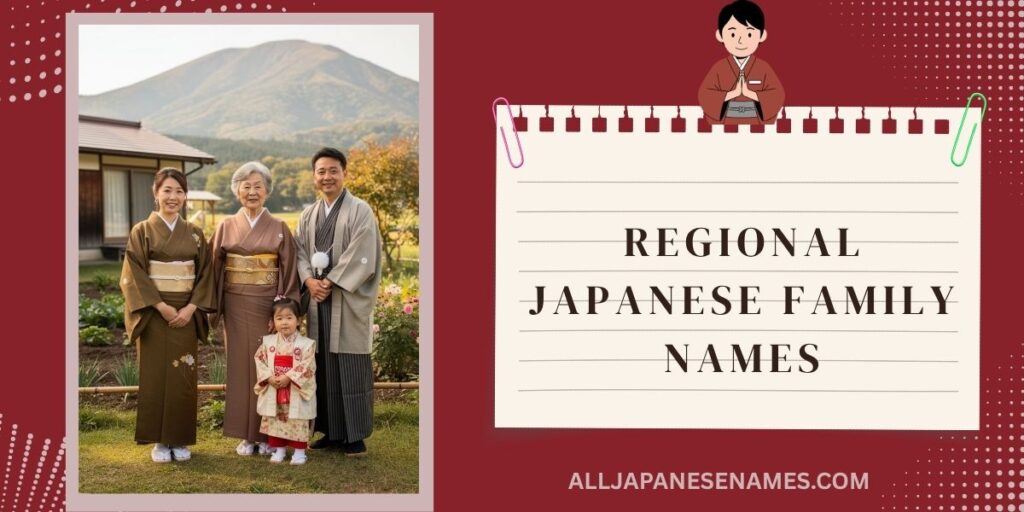
Many Japanese family names originate directly from geographical names and place names across Japan. It doesn’t matter if it’s from northwestern Japan and Hokkaido’s icy landscapes, Hokkaido’s rough Kyushu region in western Japan or the famous mountains near Mount Fuji in eastern Japan. The place where you lived changed who you became.
| Name | Meaning | Pronunciation | Kanji |
|---|---|---|---|
| Minami | South / family from the southern region of Japan | mee-nah-mee | 南 |
| Taiji | Large ground / name tied to a small Wakayama coastal town | tah-ee-jee | 太地 |
| Fujioka | Wisteria hill / name rooted near Mount Fuji’s scenic region | foo-jee-oh-kah | 藤岡 |
| Hokkaido | Northern sea road / family name inspired by Japan’s northern island | hoh-kah-ee-doh | 北海道 |
| Kyushima | Nine islands / family from the Kyushu island region | kyoo-shee-mah | 九島 |
| Tochigi | Horse chestnut tree / name from Kanto’s inland prefecture | toh-chee-gee | 栃木 |
| Shimane | Island root / ancient western Japan coastal family name | shee-mah-neh | 島根 |
| Okinawa | Rope in the open sea / southernmost island chain family name | oh-kee-nah-wah | 沖縄 |
| Tohoku | Northeast / family from Japan’s rugged northern eastern region | toh-hoh-koo | 東北 |
| Nagasaki | Long cape / family from western Kyushu’s famous port city | nah-gah-sah-kee | 長崎 |
| Sendai | Thousand generations / name from northern Japan’s largest city | sehn-dah-ee | 仙台 |
| Kagoshima | Basket island / southernmost Kyushu region family name | kah-goh-shee-mah | 鹿児島 |
| Nara | Flatland / ancient capital city of early imperial Japan | nah-rah | 奈良 |
| Wakayama | Young mountain / coastal western Japan peninsula family name | wah-kah-yah-mah | 和歌山 |
| Niigata | New lagoon / rice-rich northern coastal region family name | nee-ee-gah-tah | 新潟 |
| Akita | Autumn rice field / name from snowy northern Japan prefecture | ah-kee-tah | 秋田 |
| Yamagata | Mountain shape / northeastern Japan highland family name | yah-mah-gah-tah | 山形 |
| Kochi | High ground / family from Shikoku island’s southern coast | koh-chee | 高知 |
| Ehime | Lovely princess / name from western Shikoku island region | eh-hee-meh | 愛媛 |
| Toyama | Abundant mountain / family from central Japan’s Sea of Japan coast | toh-yah-mah | 富山 |
| Ishikawa | Stone river / family from central Japan’s Noto peninsula region | ee-shee-kah-wah | 石川 |
| Fukuoka | Blessed hill / gateway family name from northern Kyushu region | foo-koo-oh-kah | 福岡 |
| Kumamoto | Bear origin / family from central Kyushu’s castle town region | koo-mah-moh-toh | 熊本 |
| Oita | Large land / eastern Kyushu hot spring region family name | oh-ee-tah | 大分 |
| Miyazaki | Shrine cape / sunny southeastern Kyushu coastal family name | mee-yah-zah-kee | 宮崎 |
| Saga | Wise / family from northwestern Kyushu’s historic ceramic region | sah-gah | 佐賀 |
| Aomori | Blue forest / family from Japan’s northernmost Honshu prefecture | ah-oh-moh-ree | 青森 |
| Iwate | Rock hand / rugged northern Japan mountainous region family | ee-wah-teh | 岩手 |
| Fukushima | Blessed island / eastern Japan’s forested highland family name | foo-koo-shee-mah | 福島 |
| Ibaraki | Thorn tree / eastern Japan’s Pacific coast region family name | ee-bah-rah-kee | 茨城 |
Japanese Family Name Generator & How to Choose a Japanese Family Name
Before using a Japanese names generator for families, here’s a fact to know: a few of the most well-known names are actually Japanese family names that are used by actual Japanese people. Honda, Suzuki, and Toyota are all authentic surnames. Soichiro Honda, Michio Suzuki, and Kiichiro Toyota were real people who created worldwide empires and put their families’ names on every vehicle that was ever driven.
This is the power of being a Japanese name.
How do you pick one? Take note of what matters to you: the natural world, strength or history. Or maybe the sound. If you’re deciding on an individual, make sure you make sure the name’s meaning is compatible with the persona. If you’re trying to find your personal origins, begin with the geography. If you’re just looking for some inspiration for your own research, you can use a Japanese names generator for families that could mix kanji elements in random ways to come up with something unique.
Here’s an easy method Japanese people themselves employ, mentally choose a natural word, and then a location word and then combine the two. Mountains + rivers = Yamakawa. Field + forest = Morinohara. That’s how real surnames came to be across Japan.
Conclusion
Japanese family names can be more than surnames. They have a long history of Japanese history that spans from samurai clans to imperial courts, to peaceful fishing villages and farming towns. Every name listed in this guide relates a brief background about Japan’s landscape and its people, as well as its ideals.
What is what makes Japanese names unique compared in comparison to other cultures is how they link identities to nature, place and the past. The cultural differences between different regions, periods of time and social classes have all contributed to the variety of names that are in use in the present.
If you’re here to research writing fiction baby names, simply for curiosity, I hope this will give you something tangible to do with. Japanese culture is a blessing for those who are attentive. Now, you’re viewing it in the correct way.
Frequently Asked Questions
What is a Japanese good last name?
What you want to do with your Japanese name will determine the best choice. Names like Kageyama or Arashi sound meaningful and striking for fiction. Common names such as Tanaka or Nakamura are perfect for real life. Choose a name whose meaning matches your desired feeling.
What are the top 10 Japanese surnames in use?
Sato, Suzuki and Takahashi are the 10 most popular Japanese surnames. Sato is by far the most common surname in Japan. It is carried by approximately 1 in 50 Japanese across the country.
What is the normal Japanese last names?
Normal Japanese names are usually 2 kanji characters and refer to nature, geography or direction. Names such as Yamada, Inoue and Ogawa are all very common in Japan.
Is Yuki used as a Japanese surname?
Yuki is a common given name in Japan. However, it can also be used as a surname. As a family surname, it’s written as Xue or Xing. Yuki Tanaka uses Tanaka for the surname and Yuki for the first name.
What are the top 10 rarest names?
Kizugawa is one of the rarest Japanese names. Others include Namekata and Yotsumoto. These names are from obscure geographical locations and tiny regional clans that few Japanese have ever heard of.
Why are so many Japanese names derived from the word “ricefield” (Tian)?
For centuries, rice farming has been the basis of Japanese culture. When the Meiji government mandated that everyone register a name, most people named themselves after their surrounding land. This is why Tian appears in hundreds of names, including Tanaka, Yamada and Maeda.
Do Japanese married couples have to share a family name?
According to current Japanese law, married couples are legally required to share the same name. In most cases, the wife will take the husband’s name. The law has been a hot topic for many years. Many Japanese actively advocate for the right to separate surnames.
