
Japanese Dessert Names can be very confusing, especially when you’re looking at an array of menus containing Kanji and don’t know what you’re planning to consume. You may have heard the words “mochi” or “daifuku” mentioned, but what’s beyond that? It becomes blurry quickly.
This is the truth, Japanese dessert names in Japanese aren’t just random names. Each name has significance, meaning and culture that goes with it. Once you understand this, the entire world of Japanese confectionery begins to be understood.
This guide will walk you through the 50+ Japanese dessert names with meaning Kanji writing, as well as a straightforward pronunciation guide, so you’ll never get lost. No matter if you’re in Japan, going to an Asian supermarket, or simply curious about the delicious sweets You’ve come to the right spot.
In the end, you’ll know precisely what you’re ordering and what it is and what it means in terms of culture. Let’s begin.
What Do Japanese Dessert Names Actually Mean?
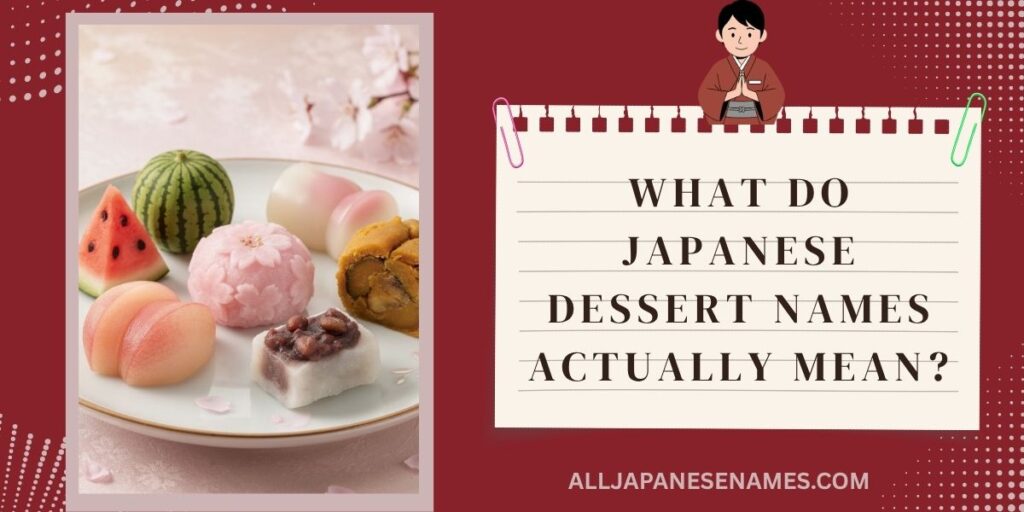
Japanese Dessert names don’t simply refer to labels; they’re little stories. They tell a story. The Japanese word for dessert can be described as “okashi” (お菓子), however, traditional sweets go beyond that one word.
They describe what’s inside, what it’s like, and even the season it is in. That’s why they’re so captivating. It’s not just an alphabet, but poems about the food.
Curious about names that blend Japanese heritage with American culture and modern appeal? Learn about American Japanese names and their meanings .
How do wagashi names describe ingredients and seasons?
Wagashi names are connected to the natural world. Seasonal ingredients play a huge part in the creation of a sweet. A spring one may be named in honor of the cherry blossoms, whereas an autumn-themed sweet might be named after leafy maples or even the moon of harvest.
Traditional aesthetics matter just as equally as the taste of Japanese confectionery. The name usually hints at the aesthetics of the appearance before even seeing the delicious confectionery.
Nature-inspired names such as “Hanabira” (flower petal) or “Kinton” (golden cloud) make a scene. It’s like each wagashi reveals the time of year it was born.
What is the difference between wagashi and yogashi names?
Here’s where the story becomes fascinating. Wagashi is a reference to traditional Japanese sweets, items made from mochi, red bean paste, rice, matcha, and mochi rice.
Yogashi is, in contrast, a term that refers to Western-style sweets that came to Japan by way of foreign influence. The names of these sweets reflect this division in a clear way.
Wagashi names have a poetic tone and are inspired by nature. Yogashi names typically employ loanwords that originate from English or French. Think of “keeki” (cake) or “kukki” (cookie). Modern influence brought new baking methods and ingredients, Japan created its own similar word, a completely different world.
Searching for versatile Japanese names that work beautifully for any gender? Look through Japanese unisex name ideas .
What Are the Most Famous Traditional Japanese Dessert Names?
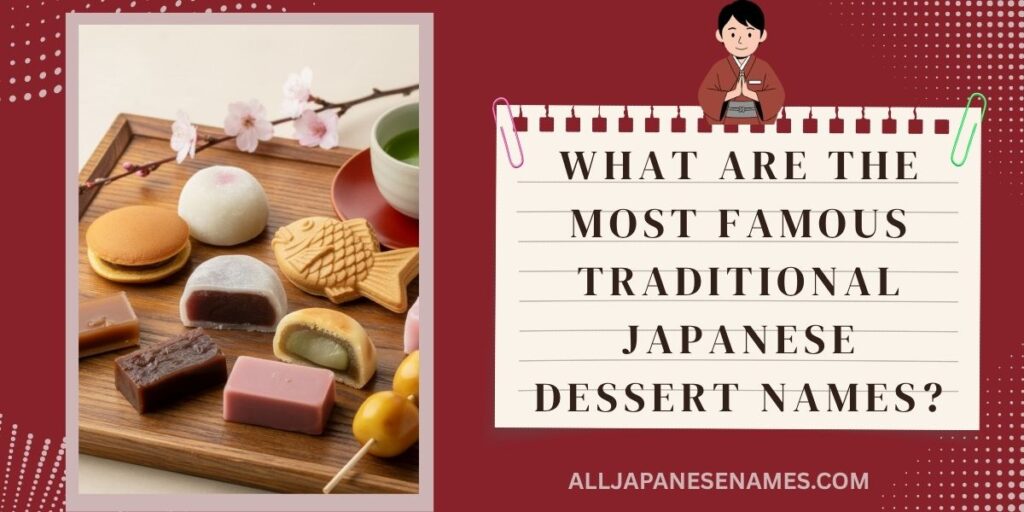
What does mochi (餅) mean and how do you say it?
Mochi is the pronunciation “moh-chee”, two simple vowels. Mochi’s meaning is derived from the Japanese word meaning rice cake that has been pounded.
It’s made with glutinous rice, which is boiled and then ground into a stretchy, soft dough. The signature chewy texture? It’s the sticky rice doing its job. What does mochi mean in Japanese? In essence, it is a rice cake, but in the present, it’s an entire class of popular Japanese sweets.
What does daifuku (大福) mean in Japanese?
Daifuku’s meaning is truly delightful and is translated to “great luck.” Its title (大福) is a combination of the words “big” and “fortune.” What a fitting name for a sweet treat, isn’t it?
It’s basically stuffed mochi, soft dough that is wrapped around the filling, typically delicious red bean paste. Certain versions contain white bean paste or strawberries inside. Every bite of this lucky dumpling is like a little celebration.
What does dango (団子) mean and where does the name come from?
Dango’s meaning is pretty straightforward. It refers to “dumpling.” The word kanji 団子 literally means something small and round. They are tiny, round savouries made of rice flour. They are cooked until soft, and then placed on skewers in groups of 3 to five. Dumplings on a skewer, that’s dango, in an easy way. The shape of the round isn’t just accidental, either. It is a common feature in Japanese culinary culture that round shapes typically represent harmony and completeness.
Why is taiyaki (鯛焼き) named after a fish?
A great question, but the solution is a lot simpler than you’d imagine. Taiyaki’s meaning is broken into two components: “tai” (鯛) refers to sea bream, and “yaki” (焼き) is grilled or baked. This literally translates to “baked sea bream.”
The fish-shaped cake is stuffed with sweet paste of red beans, and cooked in a mold of fish. Sea bream is considered a lucky fish in Japan, so the decision to name an iconic street food after it makes perfect sense culturally. The shape was a hit, as was the name.
What does dorayaki (どら焼き) mean?
Dorayaki’s meaning originates in “dora” (どら), the Japanese word meaning gong. What is a gong? The shape and form of Dorayaki is a perfect match for the shape of a flat, round gong. Dorayaki is a kind of pancake sandwich that consists of two soft, sweet pancakes joined with a thick layer of delicious red bean paste that is placed in the middle.
It’s delicious, simple and hugely loved by the masses. The majority of people outside Japan recognize it from the animated series Doraemon and the character’s favourite food.
What does yokan (羊羹) mean in Japanese?
Yokan’s meaning has an unexpected source. The word kanji 羊羹 literally means “sheep broth”, which is not the same as the food it is describing in the present. It was historically the soup of Chinese soup made of mutton. In the course of time, Japanese Buddhist monks adapted it into a vegetarian jelly dessert with red bean paste and agar.
It’s now a firm and thick chunk made of sugary jelly. The name stuck, even though the recipe changed completely, and the history of the recipe is now available to you.
What does anmitsu (あんみつ) mean?
Anmitsu’s meaning comes from combining two words “an” (餡), which means the sweet paste of red beans, along with “mitsu” (蜜), meaning syrup or honey. Combine them, and you have a vibrant, delicious dessert dish.
It is typically made up of agar-agar ice cubes, mixed fruits, red bean paste and a sprinkle of honey in black known as Kuromitsu. It’s light and not overly sweet, and appears too beautiful to take a bite of. It’s a classic summer treat from Japan.
What is namagashi (生菓子) and what does the name mean?
“Nama” (生) means fresh or raw, as well as “gashi” (菓子), which is sweets,”namagashi” simply means fresh sweets. They are made from high levels of moisture-rich ingredients, giving them a soft and delicate texture that won’t last for long. That’s intentional. Namagashi are intended to be consumed on the very same day.
They’re the highlight in this Japanese ceremonial tea, and are designed to go well with the bitter taste of matcha. Their aesthetics are part of the appeal, as each piece is designed by hand to reflect the current season.
Interested in Japanese surnames with rich history and cultural significance? Look into Japanese family name meanings .
What Are Japanese Desserts Named After Their Ingredients?
What Japanese desserts are named after red bean paste (anko)?
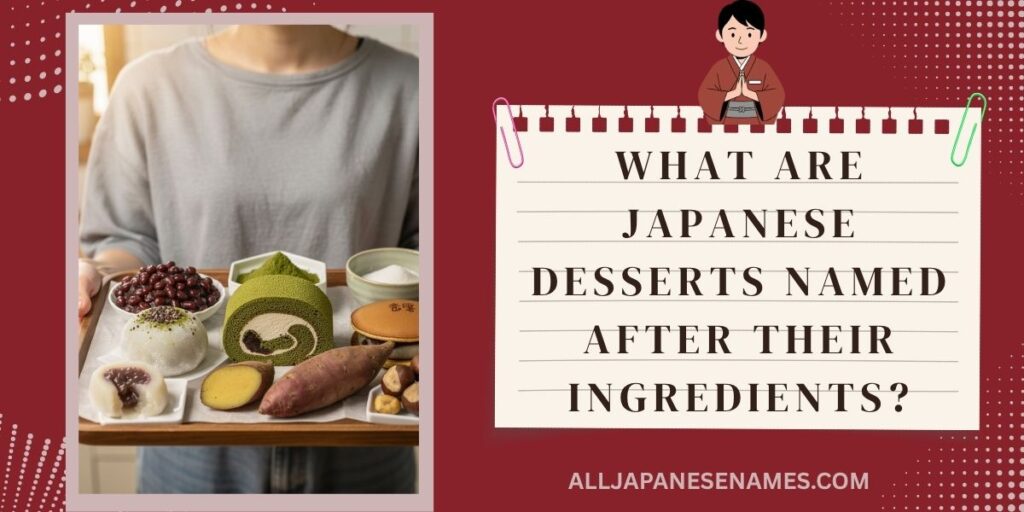
The red bean paste, commonly referred to as anko, is the main ingredient of a variety of Japanese sweets. It’s made of azuki beans and then cooked with sugar until it’s thick and sweet.
There are two major types: tsubuan, which is large with beans that are still present, and Koshi, which is silky and smooth. The sweet bean filling pops up on the menu in dorayaki, taiyaki daifuku and manju, and many more.
Many dessert names refer directly to “an” because the filling is the main attraction of the show. Here are 30 Japanese desserts named after or built around red bean paste:
| Name | Meaning | Pronunciation | Kanji |
|---|---|---|---|
| Anpan | Red bean bread roll | ahn-pahn | 餡パン |
| Ohagi | Rice ball coated in bean paste | oh-hah-gee | おはぎ |
| Ankoro | Mochi rolled in sweet bean paste | ahn-koh-roh | 餡ころ |
| Amanatto | Candied azuki beans in syrup | ah-mah-naht-toh | 甘納豆 |
| Anmaki | Bean paste rolled in thin cake | ahn-mah-kee | 餡巻き |
| Botamochi | Peony-shaped rice and bean cake | boh-tah-moh-chee | 牡丹餅 |
| Ankake | Sweet bean sauce poured over dessert | ahn-kah-keh | 餡かけ |
| Zenzai | Sweet red bean soup with mochi | zen-zai | 善哉 |
| Shiruko | Smooth red bean porridge | shee-roo-koh | 汁粉 |
| Kuzu Manju | Arrowroot dumpling filled with bean paste | koo-zoo mahn-joo | 葛饅頭 |
| Dorayaki An | Pancake filled with sweet bean | doh-rah-yah-kee ahn | どら焼き餡 |
| Oshiruko | Hot sweet bean drink with rice cake | oh-shee-roo-koh | お汁粉 |
| Kusa Mochi An | Mugwort mochi stuffed with anko | koo-sah moh-chee ahn | 草餅餡 |
| Sakura Manju | Cherry blossom steamed bun with bean filling | sah-koo-rah mahn-joo | 桜饅頭 |
| Habutae Mochi | Silk-smooth mochi with sweet bean center | hah-boo-tah-eh moh-chee | 羽二重餅 |
| Yaki Manju | Grilled bun stuffed with bean paste | yah-kee mahn-joo | 焼き饅頭 |
| Ankoro Mochi | Sticky rice cake covered in bean paste | ahn-koh-roh moh-chee | 餡ころ餅 |
| Uiro An | Steamed rice cake layered with sweet bean | oo-ee-roh ahn | 外郎餡 |
| Kintsuba | Griddle-cooked bean jelly cake | keen-tsoo-bah | 金鍔 |
| Tsuboyaki An | Pot-roasted sweet with chunky bean paste | tsoo-boh-yah-kee ahn | 壺焼き餡 |
| Mizuyokan | Soft water-based red bean jelly | mee-zoo-yoh-kahn | 水羊羹 |
| Nerikiri An | Sculpted white bean paste sweet | neh-ree-kee-ree ahn | 練り切り餡 |
| Monaka | Crispy wafer shell filled with bean paste | moh-nah-kah | 最中 |
| Imagawayaki | Round filled cake named after a bridge | ee-mah-gah-wah-yah-kee | 今川焼き |
| Karintō Manju | Deep-fried dark bun with sweet bean inside | kah-reen-toh mahn-joo | かりんとう饅頭 |
| Azuki Shiratama | White rice dumplings served with bean paste | ah-zoo-kee shee-rah-tah-mah | 小豆白玉 |
| Anko Dango | Skewered dumplings coated in bean paste | ahn-koh dahn-goh | 餡子団子 |
| Hanabiramochi An | New Year petal mochi with sweet bean | hah-nah-bee-rah moh-chee ahn | 花びら餅餡 |
| Kogashi Anpan | Lightly charred bean paste bun | koh-gah-shee ahn-pahn | 焦がし餡パン |
| Mizu Manju | Clear water jelly bun with sweet bean filling | mee-zoo mahn-joo | 水饅頭 |
What are the most popular matcha dessert names in Japanese?
Matcha dessert names are everywhere these days, and with good reason. Matcha is a very finely milled green tea powder that has an intense, bittersweet taste that is delicious when paired with sugar.
The most well-known matcha sweets include matcha mochi, matcha yokan, matcha parfait (matcha pafe), and matcha daifuku. The best versions make use of Uji matcha, which is grown within the Kyoto region’s Uji region, renowned for its rich colour and silky smooth taste.
If the name of a dessert includes “matcha,” expect a bold, earthy taste in every bite.Here are 30 popular matcha-based Japanese dessert names you should know:
| Name | Meaning | Pronunciation | Kanji |
|---|---|---|---|
| Matcha Warabi Mochi | Bracken starch jelly with green tea flavor | mah-chah wah-rah-bee moh-chee | 抹茶わらび餅 |
| Uji Kintoki | Matcha shaved ice with sweet toppings | oo-jee keen-toh-kee | 宇治金時 |
| Matcha Pudding | Creamy green tea custard pudding | mah-chah poo-deen-goo | 抹茶プリン |
| Matcha Nama Choco | Soft green tea raw chocolate | mah-chah nah-mah choh-koh | 抹茶生チョコ |
| Matcha Roll Cake | Rolled sponge cake with matcha cream | mah-chah roh-roo keh-kee | 抹茶ロールケーキ |
| Matcha Daifuku | Green tea mochi filled with cream or bean paste | mah-chah dai-foo-koo | 抹茶大福 |
| Matcha Monaka | Crispy wafer filled with green tea paste | mah-chah moh-nah-kah | 抹茶最中 |
| Matcha Yokan | Firm green tea jelly block | mah-chah yoh-kahn | 抹茶羊羹 |
| Matcha Financier | French-style almond cake with green tea | mah-chah fee-nahn-sheh | 抹茶フィナンシェ |
| Matcha Mille-feuille | Layered pastry with matcha cream | mah-chah mee-roo-fyoo | 抹茶ミルフィーユ |
| Matcha Chiffon Cake | Light airy sponge with green tea flavor | mah-chah shee-fohn keh-kee | 抹茶シフォンケーキ |
| Matcha Soft Cream | Soft-serve ice cream with green tea | mah-chah soh-futo koo-ree-moo | 抹茶ソフトクリーム |
| Matcha Taiyaki | Fish-shaped cake with green tea batter | mah-chah tah-ee-yah-kee | 抹茶鯛焼き |
| Matcha Anmitsu | Green tea jelly bowl with sweet toppings | mah-chah ahn-mee-tsoo | 抹茶あんみつ |
| Matcha Crepe | Thin green tea crepe with whipped cream | mah-chah koo-reh-poo | 抹茶クレープ |
| Matcha Tiramisu | Italian-inspired dessert with green tea twist | mah-chah tee-rah-mee-soo | 抹茶ティラミス |
| Matcha Baum | Green tea layered tree-ring cake | mah-chah bah-oo-moo | 抹茶バウム |
| Matcha Waffle | Crispy grid cake with green tea batter | mah-chah wah-foo-roo | 抹茶ワッフル |
| Matcha Dorayaki | Green tea pancake sandwich with bean paste | mah-chah doh-rah-yah-kee | 抹茶どら焼き |
| Matcha Mochi Ice | Green tea rice cake wrapped around ice cream | mah-chah moh-chee ah-ee-soo | 抹茶餅アイス |
| Matcha Kuzu Kiri | Arrowroot noodles served with matcha syrup | mah-chah koo-zoo kee-ree | 抹茶葛切り |
| Matcha Castella | Portuguese-style sponge cake with green tea | mah-chah kah-soo-teh-rah | 抹茶カステラ |
| Matcha Parfait | Layered glass dessert with green tea flavor | mah-chah pah-feh | 抹茶パフェ |
| Matcha Nerikiri | Hand-molded green tea bean paste sweet | mah-chah neh-ree-kee-ree | 抹茶練り切り |
| Matcha Kakigori | Shaved ice dessert topped with green tea syrup | mah-chah kah-kee-goh-ree | 抹茶かき氷 |
| Matcha Langues de Chat | Thin crispy green tea butter cookies | mah-chah rahn-goo-doh-shah | 抹茶ラングドシャ |
| Matcha Nama Cake | Fresh green tea layered cream cake | mah-chah nah-mah keh-kee | 抹茶生ケーキ |
| Matcha Zenzai | Green tea sweet bean soup with rice cake | mah-chah zen-zai | 抹茶善哉 |
| Matcha Tart | Buttery tart shell with green tea cream filling | mah-chah tah-roo-toh | 抹茶タルト |
| Matcha Shiroan | White bean paste mixed with green tea flavor | mah-chah shee-roh-ahn | 抹茶白餡 |
Planning a Japanese-themed café, sushi bar, or dining business? Pick from creative Japanese restaurant names .
What Japanese desserts are named after rice?
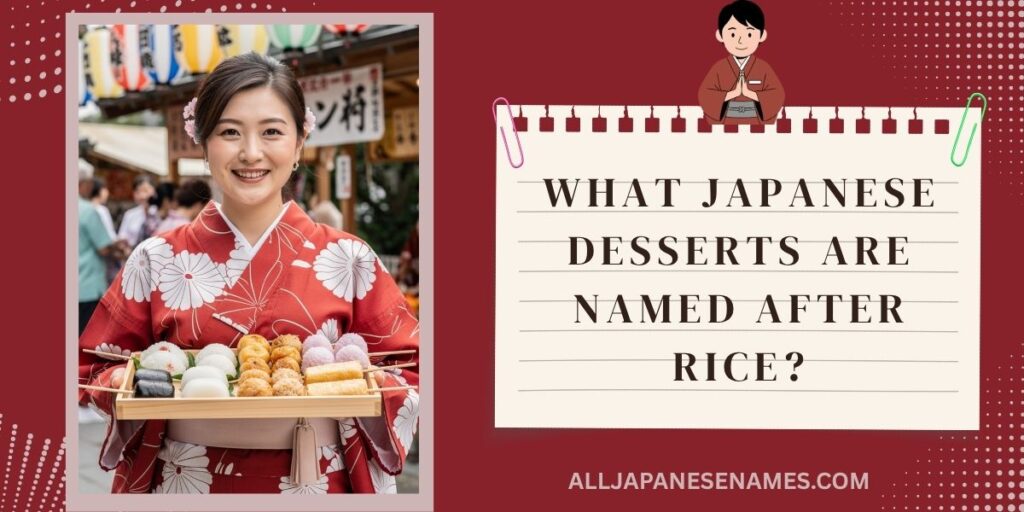
Rice is the basis of Japanese food culture, and it is evident in desserts. Rice cakes like mochi and dango are among the most well-known examples.
There’s also sekihan, which is a delicious sweet and sticky rice dessert that is made using azuki beans and the ohagi, named after its slightly rougher texture compared to the non-glutinous rice.
These staples of the past have been an integral part of Japanese celebrations for hundreds of years. The rice isn’t merely an ingredient, it’s the entire essence of the dish.Here are 30 Japanese rice-based dessert names:
| Name | Meaning | Pronunciation | Kanji |
|---|---|---|---|
| Shiratama Dango | White rice flour dumplings on skewer | shee-rah-tah-mah dahn-goh | 白玉団子 |
| Kiri Mochi | Cut and dried rectangular rice cake | kee-ree moh-chee | 切り餅 |
| Hishi Mochi | Diamond-shaped tricolor rice cake | hee-shee moh-chee | 菱餅 |
| Uiro | Steamed sweet rice flour cake | oo-ee-roh | 外郎 |
| Sekihan | Festive red rice with azuki beans | seh-kee-hahn | 赤飯 |
| Chimaki | Bamboo-wrapped glutinous rice sweet | chee-mah-kee | 粽 |
| Ponzu Mochi | Rice cake served with citrus dipping sauce | pohn-zoo moh-chee | ポン酢餅 |
| Abekawa Mochi | Rice cake dusted with kinako and sugar | ah-beh-kah-wah moh-chee | 安倍川餅 |
| Isobeyaki | Grilled rice cake wrapped in nori seaweed | ee-soh-beh-yah-kee | 磯辺焼き |
| Karinto Mochi | Crunchy deep-fried sweet rice cake | kah-reen-toh moh-chee | かりんとう餅 |
| Hanabira Mochi | Petal-shaped New Year rice sweet | hah-nah-bee-rah moh-chee | 花びら餅 |
| Warabi Mochi | Bracken-starch jelly cake similar to rice mochi | wah-rah-bee moh-chee | わらび餅 |
| Yomogi Mochi | Mugwort-infused green rice cake | yoh-moh-gee moh-chee | よもぎ餅 |
| Mitarashi Dango | Skewered rice dumplings with soy glaze | mee-tah-rah-shee dahn-goh | みたらし団子 |
| Hanami Dango | Tricolor flower-viewing rice dumplings | hah-nah-mee dahn-goh | 花見団子 |
| Tsukimi Dango | Moon-viewing rice dumplings | tsoo-kee-mee dahn-goh | 月見団子 |
| Kusamochi | Green herb rice cake made with mugwort | koo-sah-moh-chee | 草餅 |
| Kakimochi | Dried and fried seasoned rice cracker cake | kah-kee-moh-chee | 柿餅 |
| Bocchan Dango | Three-color sweet dango from Matsuyama | boh-chahn dahn-goh | 坊っちゃん団子 |
| Ohagi Shiro | White sesame-coated sticky rice ball | oh-hah-gee shee-roh | おはぎ白 |
| Nishiki Mochi | Brocade-patterned multicolor rice cake | nee-shee-kee moh-chee | 錦餅 |
| Azuki Gohan | Sweet red bean rice dessert bowl | ah-zoo-kee goh-hahn | 小豆ご飯 |
| Tamba Dango | Rustic black sesame rice dumplings from Tamba | tahm-bah dahn-goh | 丹波団子 |
| Kinako Mochi | Rice cake coated in roasted soybean powder | kee-nah-koh moh-chee | きな粉餅 |
| Yukimi Daifuku | Snow-viewing ice cream rice cake | yoo-kee-mee dai-foo-koo | 雪見だいふく |
| Fuyugomori | Winter hibernation themed soft rice sweet | foo-yoo-goh-moh-ree | 冬ごもり |
| Kusa Dango | Green herb skewered rice dumplings | koo-sah dahn-goh | 草団子 |
| Shiratama Zenzai | White rice dumplings in sweet bean soup | shee-rah-tah-mah zen-zai | 白玉善哉 |
| Mochibana | Flower-shaped rice cake for New Year decoration | moh-chee-bah-nah | 餅花 |
| Kuzu Sakura | Cherry blossom shaped arrowroot rice sweet | koo-zoo sah-koo-rah | 葛桜 |
What are Japanese sweet potato dessert names?
Japanese sweet potato dessert names can be closely associated with one ingredient, satsuma, which is the Japanese skin-colored sweet potato. It is naturally rich, sweet flesh that is bursting with beautiful roasted flavor when cooked.
The most popular desserts are daigaku-imo (candied sweet potatoes), Imo yokan (sweet potatoes in a jelly), as well as sweet potato tarts that are sold in Japanese bakeries.
These are the classic autumn foods, such as those you’ll see at autumn festivals or in wagashi collections for seasonal events as the temperatures cool down. Here are 30 Japanese sweet potato dessert names worth knowing:
| Name | Meaning | Pronunciation | Kanji |
|---|---|---|---|
| Daigaku Imo | University sweet potato — candied fried chunks | dai-gah-koo ee-moh | 大学芋 |
| Imo Yokan | Sweet potato jelly block | ee-moh yoh-kahn | 芋羊羹 |
| Yakiimo | Roasted whole sweet potato | yah-kee-ee-moh | 焼き芋 |
| Satsumaimo Mochi | Sweet potato rice cake | saht-soo-mah-ee-moh moh-chee | 薩摩芋餅 |
| Imo Kinton | Mashed sweet potato with golden chestnut | ee-moh keen-tohn | 芋きんとん |
| Imo Manju | Sweet potato steamed bun | ee-moh mahn-joo | 芋饅頭 |
| Beni Imo Tart | Purple sweet potato tart from Okinawa | beh-nee ee-moh tah-roo-toh | 紅芋タルト |
| Imo Anmitsu | Sweet potato jelly dessert bowl | ee-moh ahn-mee-tsoo | 芋あんみつ |
| Satsumaimo Pudding | Smooth sweet potato custard pudding | saht-soo-mah-ee-moh poo-deen-goo | さつまいもプリン |
| Imo Dango | Sweet potato rice flour dumplings | ee-moh dahn-goh | 芋団子 |
| Imo Karinto | Crunchy fried sweet potato snack sticks | ee-moh kah-reen-toh | 芋かりんとう |
| Murasaki Imo Soft | Purple sweet potato soft serve ice cream | moo-rah-sah-kee ee-moh soh-futo | 紫芋ソフト |
| Imo Castella | Sweet potato sponge cake | ee-moh kah-soo-teh-rah | 芋カステラ |
| Imo Chipsukan | Sweet potato chip candy | ee-moh cheep-soo-kahn | 芋チップス菓子 |
| Imo Nerikiri | Hand-shaped sweet potato wagashi | ee-moh neh-ree-kee-ree | 芋練り切り |
| Satsumaimo Mont Blanc | Chestnut-style dessert made with sweet potato | saht-soo-mah-ee-moh mohn-burahn | さつまいもモンブラン |
| Beni Imo Yokan | Purple sweet potato jelly block | beh-nee ee-moh yoh-kahn | 紅芋羊羹 |
| Imo Dorayaki | Pancake sandwich filled with sweet potato cream | ee-moh doh-rah-yah-kee | 芋どら焼き |
| Imo Baum Kuchen | Layered ring cake with sweet potato flavor | ee-moh bah-oo-moo koo-hhen | 芋バウムクーヘン |
| Imo Monaka | Crispy wafer filled with sweet potato paste | ee-moh moh-nah-kah | 芋最中 |
| Imo Roll Cake | Rolled sponge filled with sweet potato cream | ee-moh roh-roo keh-kee | 芋ロールケーキ |
| Imo Zenzai | Sweet potato and red bean warm dessert soup | ee-moh zen-zai | 芋善哉 |
| Imo Warabi | Sweet potato flavored bracken jelly | ee-moh wah-rah-bee | 芋わらび |
| Imo Steamed Cake | Fluffy steamed sweet potato muffin cake | ee-moh moo-shee keh-kee | 芋蒸しケーキ |
| Imo Parfait | Sweet potato layered glass dessert | ee-moh pah-feh | 芋パフェ |
| Imo Ohagi | Sweet potato coated sticky rice ball | ee-moh oh-hah-gee | 芋おはぎ |
| Imo Daifuku | Sweet potato filled lucky mochi | ee-moh dai-foo-koo | 芋大福 |
| Imo Kakigori | Shaved ice with sweet potato syrup topping | ee-moh kah-kee-goh-ree | 芋かき氷 |
| Imo Financier | Almond butter cake with roasted sweet potato | ee-moh fee-nahn-sheh | 芋フィナンシェ |
| Imo Cream Taiyaki | Fish-shaped cake filled with sweet potato cream | ee-moh koo-ree-moo tah-ee-yah-kee | 芋クリーム鯛焼き |
Interested in flowers that hold special meanings in Japanese culture and tradition? Learn the meanings behind Japanese flower names .
What Does Purin (プリン) Mean and Where Does the Name Come From?
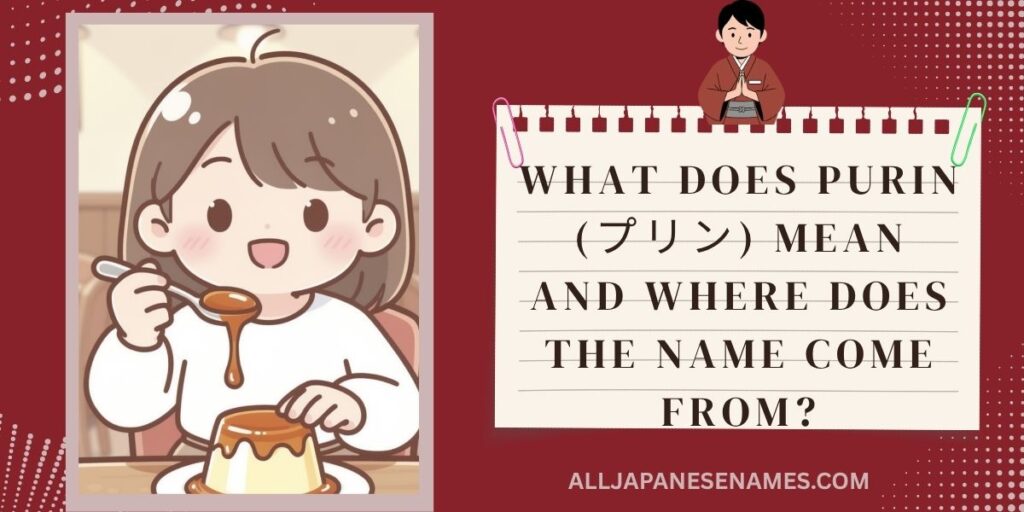
Purin is an example of the Japanese version of the English word “pudding.” When custard pudding of Western style came to Japan, locals altered the word to suit Japanese phonetics, and thus purin was born.
But Japan didn’t just copy it. They made it more smooth and silkier as well as more jiggly than the Western version. Purin today is in its own space as a classic yogashi that is totally Japanese despite its origins in the United States. It is available in cafes, convenience stores and fancy patisseries throughout the nation.
Why is mizu shingen mochi called the “raindrop cake”?
The name says it all. Mizu shingen mochi’s meaning breaks down into a simple phrase, “mizu” means water, while “shingen mochi” refers to the original rice cake of Yamanashi Prefecture.
The version we’re talking about replaces rice with agar made of water placed in an incredibly clear and round dome. It’s jelly-like and almost transparent, and really seems like a gigantic raindrop that is sitting on your plate. It’s soft, almost sweet, and melted almost immediately. This alone is the reason it was a huge hit across the world.
What does kakigori (かき氷) mean in Japanese?
Kakigori’s meaning comes straight from the act of shaving, “kaku” (かく) is a term used to describe slicing or scraping, while “kori” (氷) means ice. It literally refers to shaving ice. However, kakigori is not like a simple snow cone.
The ice is chopped into thin, light layers that melt in your mouth. It’s then topped with flavor-infused condensed milk, syrups, and red bean powder if you walk around every Japanese celebration in the summer and find Kakigori stalls on every corner and is a must-have for warm weather.
Fascinated by legendary blades, samurai history, and powerful weapon names? Uncover Japanese sword names and their meanings .
What does ichigo sando (いちごサンド) mean?
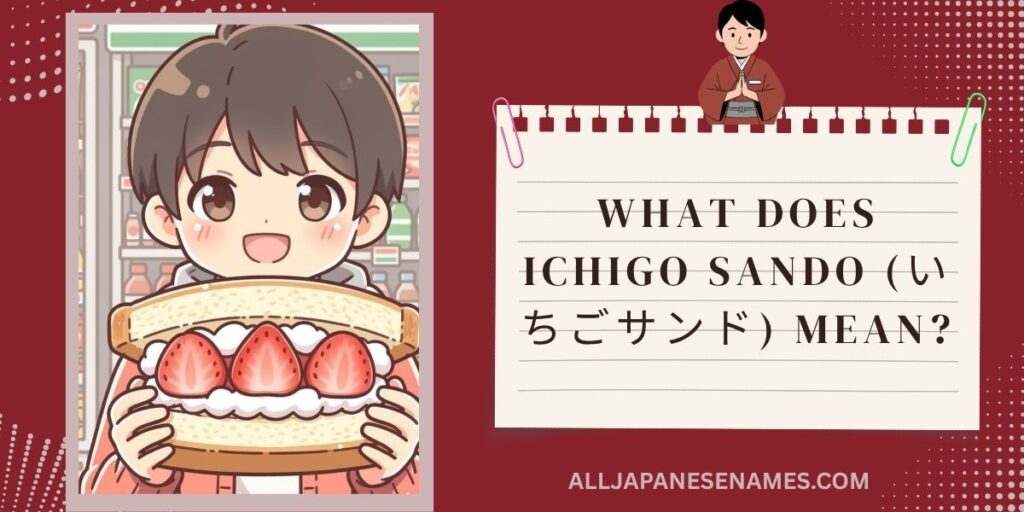
Ichigo sando literally translates to strawberry sando “Ichigo” means strawberry, and “sando” is short for sandwich. The concept is straightforward, but the result is breathtaking.
Fresh strawberries are sandwiched between fluffy white bread and topped with clouds of sweet whipped cream, lightly sweetened. The fruit sandwich became popular on social media due to the stunning way it looks when cut into slices, and it is a perfect blend of white and red berries.
Japanese grocery stores offer a lot of these sandwiches every day, especially during strawberry season.
What does castella (カステラ) mean and why does it have a Portuguese name?
Castella’s meaning traces back to “Pao de Castela”, Portuguese for “bread from Castile,” an area in Spain. Portuguese traders brought this sponge cake recipe to Japan through Nagasaki in the 16th century.
Japanese bakers modified the recipe and refined it into something that was unique, soft and sweet and honey-sweet. Nagasaki castella developed into its own speciality, different in comparison to the traditional one.
Nagasaki castella was distinctly different from the original. The Portuguese name has stuck since the Japanese have never attempted to rename the dessert. It’s not often that the origin of a dessert is prominently preserved by its name.
What is pon de ring and what does the name mean?
Pon de Ring The ring of Pon is Mister Donut Japan’s most iconic creation. The name originates directly from “pao de queijo”, which is a Brazilian dough ball that is chewy, which inspired the texture.
Its “ring” part is obvious, and it’s designed to resemble the ring that connects smaller doughballs. It is made from tapioca starch. Mochi donuts have the chewy, stretchy texture that’s totally distinct from regular donuts.
You can pull one ball, and the whole ring will stretch satisfyingly. It’s easy, enjoyable and completely addictive.
What are Japanese dessert names in Japanese script (kanji & romaji)?
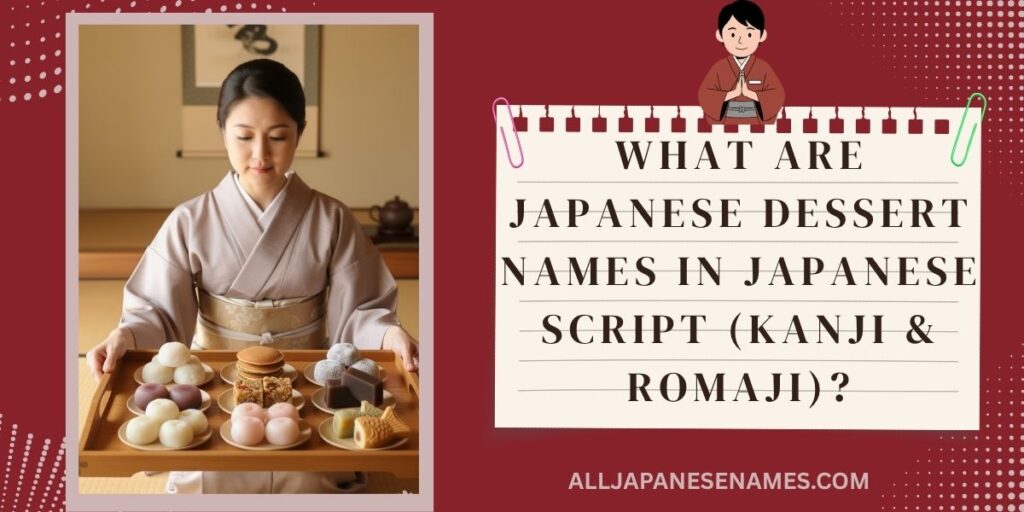
The process of reading Japanese dessert names becomes easier when you know the 3 scripts. Kanji are Chinese-derived characters that have meaning for a variety of reasons, such as 餅 for mochi and 団子 for dango. Hiragana is a soft, curving script that is used for native Japanese words.
You’ll find it in titles like the word あんみつ (anmitsu). Katakana is more blocky and specially designed for foreign-language words, which is why words like it is why プリン (purin) and the word カステラ(castella) are common in Katakana.
Romaji is simple Japanese, which is written using English letters, which makes pronunciation simpler for those who are new to it. Reading Japanese names becomes far easier once you understand the script you should expect to see and the reason behind it.
Which Japanese Regions Have Their Own Famous Dessert Names?
Japan has no uniform standard for confectionery. Each region’s community, local produce, and historic influences give rise to a multiplicity of delightful specialties. These famed subtle sweets serve as edible charms, giving guests a sense of place.
What Is the Famous Dessert Name From Kyoto?
The most popular sweet in Kyoto is yatsuhashi. There are baked and unbaked types. The unbaked are made of red bean paste inside a triangle of rice dough.
The baked are cinnamon wafers. Cinnamon is the main flavor of yatsuhashi and is warming. Yatsuhashi has been the king of unbaked sweets for more than 300 years.
What Does Momiji Manju Mean and Why Is It Shaped Like a Leaf?
The translation of the term Momiji Manju means “leaves” and “steamed bun”, which indicates a pastry in the shape of a leaf which contains red bean paste.
This adorable dessert comes from Hiroshima and more specifically from the region of Mt. Miyajima, which is packed full of maple trees coloring the landscape in autumn.
This dessert also honors the beautiful view of the landscape. Along with red bean, the popular momiji manju also comes in chocolate, matcha, and custard.
What Is the Famous Dessert Name From Nagasaki?
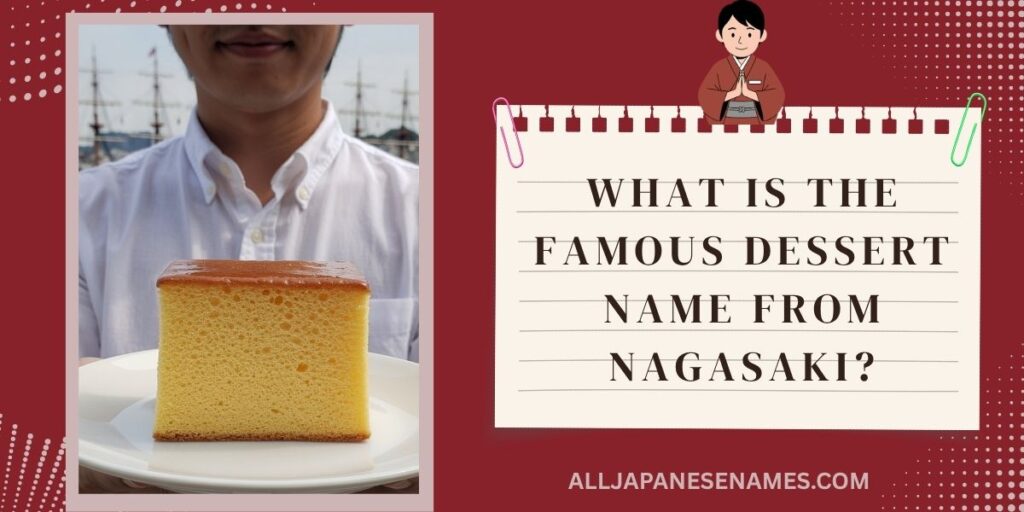
There are many things to love about Japan, but Castella from Nagasaki is one dessert you don’t want to miss. Understanding Castella is akin to understanding the history of Nagasaki’s port. Castella has some stories to tell about the Portuguese. Nagasaki was the only open port during Japan’s time of seclusion.
The 16th-century Portuguese merchants and missionaries brought sponge cake to Japan, and along with it, the beginnings of Castella! Portuguese merchants and missionaries were able to cater for the dessert to the locals ‘ dessert needs, and it found a place in Nagasaki’s history.
Nagasaki’s Castella is a box of history for many. The rest of us? We simply enjoy a slice of the cake.
What Does Tokyo Banana Mean and Why Is It Famous?
With a name like Tokyo Banana, one would naturally picture a banana-shaped cake. In this case, you’d be both right and wrong! Why? Because, like all things famous in Tokyo, the banana cake is a must-try as you tour.
Every great product has originality and exceptional aesthetics, and this cake has both.
Tokyo Banana’s cake has us excited! It’s one of the most delightful and creative omiyage (souvenir) to invade the Japanese markets!
What Are Okinawan Dessert Names?
Okinawa’s dessert customs create opportunities to celebrate its distinct culture and lifestyle. A prominent example is Doughnut Sata Andagi, or simply “sata.” Fried to a golden brown, these dense, round cakes are not doughnuts as we know them. A deep-fried exterior is slightly crispy with a cushiony, cake-like interior.
The Okinawan dialect contributes to the creation of the name, sata, meaning sugar, and “andagi” meaning deep-fried. A touch of brown sugar gives these cakes a tantalizing, rich sweetness.
The small stir of ingredients creates quite the flavor, thus contributing to the popularity of the dessert, one that can always be found at local fairs or festivals in Okinawa throughout the year.
What Are the Cutest Japanese Dessert Names and What Do They Mean?
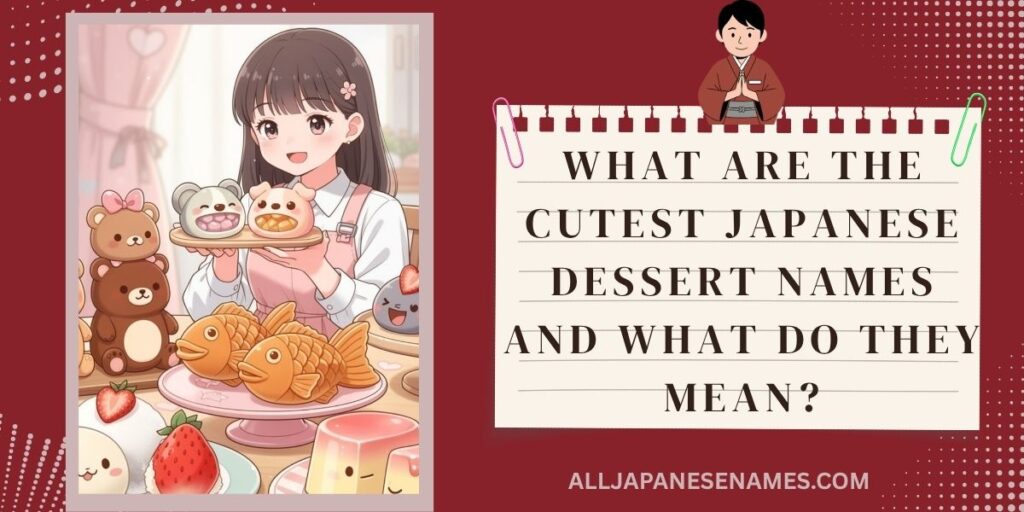
Certain Japanese desserts have poetic names, as if they seem like Song titles.
The sweets weren’t created to impress. They were named to represent particular seasons, moments and even feelings. This is what makes them distinctive.
What Does Yukimi Daifuku (雪見だいふく) Mean?
The word “yukimi daifuku” literally means “snow-viewing great luck.” “Yuki” means snow, “mi” means viewing, and daifuku is a word that means good fortune.
It’s a winter-themed snack in the fullest sense. It’s a small, round mochi, where the delicious vanilla ice cream is within an extremely soft, thin mochi layer.
The idea is to enjoy it while you watch the snow falling outside. It’s now a brand name, however, the poetic nature of the name originally stuck with the public.
What Does Hanami Dango (花見団子) Mean?
Hanami dango meaning can be described as pure springtime “Hanami” means flower-viewing, and “dango” means dumplings.
They can be described as the dumplings with three colors that you will see all over the place during the springtime in Japan. Pink on top represents spring flowers and white between, with green at the bottom, made of mugwort.
They’re skewered, then taken while sitting in the shade of flowers. The name places you in the present while sitting outside, looking up at flowers, and having a snack with a drink in your hands. Spring vibes don’t get more Japanese than this.
What Does Sakura Mochi (桜餅) Mean?
Sakura mochi’s meaning is straightforward, “sakura” means cherry blossom, and “mochi” means rice cake. The red rice cake is much more multi-layered than its name suggests. It’s wrapped with a salted cherry leaf that could be edible.
The contrast of sweet pink mochi versus the slightly salty, sweet cherry blossom leaf is what makes this dish unforgettable.
The salt isn’t overwhelming. It makes it more balanced. Sakura mochi can be described as a traditional springtime sweet that is deeply connected to the Hanami culture as well as the delicate beauty of cherry blossoms when they are in full bloom.
What Does Ichigo Daifuku (いちご大福) Mean?
Ichigo daifuku means “strawberry great luck.” Simple name, clever concept. A whole strawberry is in the heart, surrounded by a delicious red bean paste and wrapped in mochi dough that is soft and chewy.
It’s a delicious blend of fresh fruit, sweet beans and chewy rice cake in every bite. It’s considered to be a modern wagashi. It’s a brand new version that focuses on traditional methods but adds a new twist.
It was invented in the 1980s, and this quickly became one of Japan’s most loved daily sweets.
Final Thoughts
Knowing Japanese dessert names is useful. Each dessert name has a story. Some names describe the ingredients, or the season when that dessert is made, or names that describe the place it came from, or perhaps even names that describe the history of a culture. The names can even describe the feelings of the maker. There are names of desserts that even trace back generations. The names have layers. For example, Daifuku are called Daifuku because of the “great luck” that lives inside them. There is a romantic meaning of snow viewing behind the dessert Yukimi Daifuku.
There is a Japanese bakery in Richardson. There are plans to go to that bakery. There is value to knowing the names. You appreciate more than just the taste. You appreciate the history.
Knowing the names of Japanese desserts will make a Japanese dessert menu look less confusing. There is value to knowing the names of desserts.
Frequently Asked Questions
Q1: What is the most popular dessert in Japan?
Mochi is probably the most loved dessert in Japan. It’s enjoyed all year round and is available in a variety of flavors, and has a significant cultural significance. The convenience stores, specialty shops and all festivals have it in some way.
Q2: What does “mochi” mean in Japanese?
Mochi is a “rice cake” in Japanese. It’s made with glutinous rice, which is pounded into a chewy, soft, elastic dough. The name is an accurate description of what it’s made of, simply a straightforward, honest brand name for a well-known sweet.
Q3: What are traditional Japanese sweets called?
The traditional Japanese sweets are referred to as wagashi. They are confections that are made by hand using natural ingredients such as white bean paste, rice flour, and matcha. They are closely linked to the tea ceremony and celebrations of the season.
Q4: How to say Japanese dessert names correctly?
Japanese pronunciation is consistent. Every syllable is clearly spoken and uniformly. For instance, “da-i-fu-ku” not “day-foo-kah.” Reading the romaji (Japanese writing in English writing) is the most basic beginning point for newbies.
Q5: What is the Japanese word for dessert?
The Japanese term to describe desserts, can be described as “okashi” (お菓子), generally translates to sugary or sweet. There is also “dezato” – a loanword that is derived direct from the English phrase “dessert” used in modern contexts.
Q6: How do you pronounce Japanese dessert names correctly?
Every vowel used in Japanese is pronounced the same way each time – “a” as in “ah,” “i” as in “ee,” “u” as in “oo.” Thus, “taiyaki” is simply “tai-yah-kee.” After you have learned the vowel sounds in the five vowels, the names get easier to comprehend.
